Skip to content

The AI Forecasting Revolution in Finance
Financial forecasting has undergone a fundamental transformation. What was once a labor-intensive process built on spreadsheets, historical patterns, and educated guesses has evolved into a dynamic, real-time system powered by artificial intelligence. This shift represents more than an incremental improvement, it’s a complete reimagining of how finance teams approach the future.
Traditional forecasting methods rely heavily on historical data and manual analysis, often resulting in forecasts that quickly become outdated in today’s rapidly changing business environment. AI forecasting, by contrast, continuously processes vast amounts of financial data, detecting patterns and relationships that human analysts might miss, while adapting to new information in real-time.
For CFOs, this technological leap forward means moving from reactive to proactive financial management. Rather than discovering cash flow shortfalls after they occur or identifying risks once they’ve already impacted the business, AI forecasting provides early warning signals that allow finance leaders to take corrective action before problems materialize.
Why Traditional Forecasting Falls Short
- Limited ability to process large volumes of data quickly
- Reliance on historical patterns that may not predict future events
- Manual processes prone to human error and bias
- Static models that don’t adapt to changing conditions
- Time lag between data collection and insight generation
These limitations create significant blind spots for finance leaders. When forecasts are based primarily on historical data and manual analysis, they often fail to capture emerging trends, unexpected market shifts, or complex interrelationships between variables. The result is a forecasting approach that works reasonably well in stable conditions but breaks down precisely when accurate forecasting matters most during periods of volatility and change.
Core Capabilities of AI-Powered Financial Forecasting
AI forecasting represents a fundamental shift in how finance teams approach prediction and planning. By leveraging advanced algorithms, machine learning, and vast data processing capabilities, these systems deliver insights that were previously impossible to obtain. Let’s examine the core capabilities that make AI forecasting transformative for CFOs.
Real-Time Cash Flow Visualization
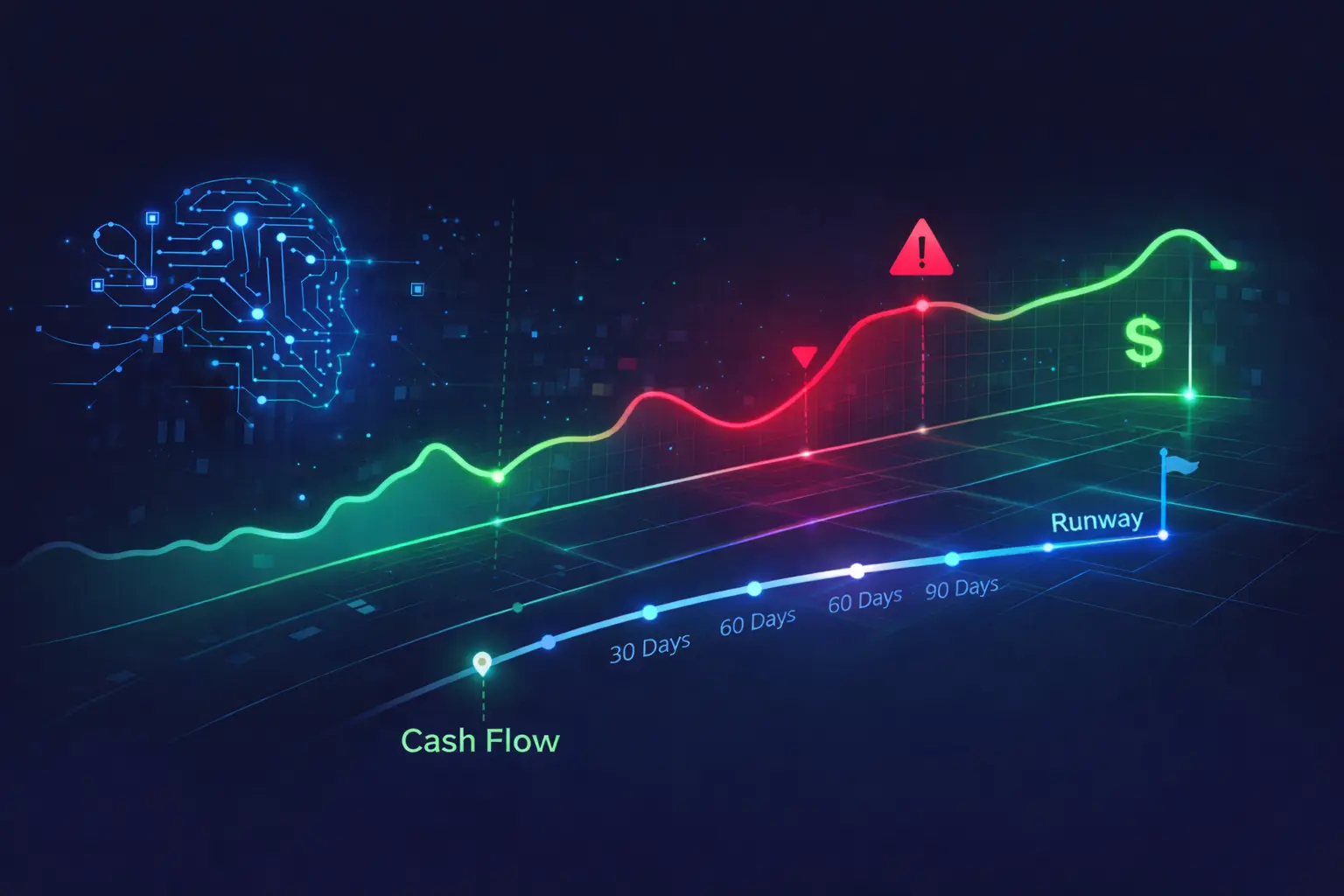
AI forecasting systems provide dynamic, real-time visualizations of cash flow that go far beyond traditional reports. These visualizations don’t just show what’s happening now, they project future cash positions based on a comprehensive analysis of historical patterns, current transactions, and external factors. For CFOs, this means gaining the ability to:
- View projected cash positions across multiple time horizons (30, 60, 90+ days)
- Identify potential cash shortfalls weeks or months before they occur
- Understand seasonal patterns and cyclical trends with greater precision
- Visualize the impact of pending transactions on overall cash position
- Track cash flow velocity and conversion cycles in real-time
This enhanced visibility transforms cash management from a reactive exercise into a strategic advantage. Rather than scrambling to address unexpected shortfalls, finance teams can implement proactive measures to optimize cash utilization and ensure adequate liquidity.
Predictive Risk Identification
Perhaps the most valuable aspect of AI forecasting is its ability to identify financial risks before they materialize. Traditional risk management often relies on lagging indicators by the time a risk is identified, it’s already impacting the business. AI forecasting changes this dynamic by:
- Continuously monitoring key risk indicators across the business
- Detecting subtle pattern changes that might signal emerging problems
- Analyzing correlation between different financial variables
- Assessing the probability and potential impact of identified risks
- Providing early warning alerts when risk thresholds are approached
This predictive approach to risk management gives CFOs the time and information needed to implement mitigation strategies before problems escalate. Whether it’s identifying potential customer payment defaults, detecting unusual expense patterns, or flagging compliance issues, AI forecasting provides the advance notice needed to take corrective action.
Accurate Runway Calculation
For businesses of all sizes, from startups to established enterprises, understanding the financial runway is critical. AI forecasting enhances runway calculations by incorporating a broader range of variables and continuously updating projections based on the latest data. This capability enables finance leaders to:
- Calculate runway across multiple scenarios with greater accuracy
- Identify the key drivers that most significantly impact runway
- Receive automatic alerts when runway projections change significantly
- Model the impact of potential cost-cutting or revenue-generating initiatives
- Visualize runway inflection points and critical decision timelines
With AI-powered runway calculations, CFOs gain confidence in their planning horizons and can make more informed decisions about investments, hiring, and strategic initiatives. This precision is particularly valuable during periods of uncertainty or when navigating challenging market conditions.
How AI Integrates and Analyzes Financial Data
The power of AI forecasting stems from its ability to integrate and analyze vast amounts of data from disparate sources. Unlike traditional forecasting methods that often rely on a limited set of financial metrics, AI systems can incorporate data from across the organization and beyond, creating a more comprehensive and accurate picture of financial health.
Comprehensive Data Integration
AI forecasting platforms connect to multiple data sources, both internal and external, to build a holistic view of financial performance. This integration capability allows the system to:
- Pull transaction data from accounting systems, ERPs, and banking platforms
- Incorporate CRM data to analyze sales pipelines and customer payment patterns
- Connect to operational systems to understand production costs and supply chain dynamics
- Access market data, economic indicators, and industry benchmarks
- Process unstructured data from news sources, social media, and customer interactions
By bringing together these diverse data streams, AI forecasting creates a more complete financial picture than was previously possible. This comprehensive approach ensures that forecasts reflect not just historical financial performance but also current operational realities and external market conditions.
Advanced Pattern Recognition
Once data is integrated, AI systems apply sophisticated algorithms to identify patterns, correlations, and anomalies that might escape human analysts. These pattern recognition capabilities enable the system to:
- Detect subtle trends that might signal future financial shifts
- Identify relationships between seemingly unrelated variables
- Recognize cyclical patterns across different time horizons
- Flag anomalies that deviate from expected patterns
- Learn from new data to continuously improve predictive accuracy
This advanced pattern recognition forms the foundation of AI’s predictive capabilities. By understanding how different variables have interacted in the past and how they’re changing in the present, the system can make more accurate projections about future financial performance.
Continuous Learning and Adaptation
Perhaps the most powerful aspect of AI forecasting is its ability to learn and adapt over time. Unlike static forecasting models that must be manually updated, AI systems continuously refine their understanding based on new data and outcomes. This adaptive capability means:
- Forecasts become more accurate as the system processes more historical data
- The system learns from forecasting errors to improve future predictions
- Models automatically adjust to changing business conditions and market dynamics
- Seasonal patterns and cyclical trends are recognized and incorporated into forecasts
- The impact of one-time events can be isolated from underlying performance trends
This continuous learning process ensures that AI forecasting systems become more valuable over time. As they process more data and observe more outcomes, their predictive accuracy improves, providing CFOs with increasingly reliable insights for decision-making.
Practical Benefits for CFOs and Finance Teams
The advanced capabilities of AI forecasting translate into tangible benefits for finance leaders and their teams. By implementing these systems, CFOs can transform their approach to financial management and deliver greater strategic value to their organizations.
Proactive Problem Prevention
Perhaps the most significant benefit of AI forecasting is the ability to identify and address potential problems before they impact the business. This proactive approach allows finance teams to:
- Spot potential cash shortfalls weeks or months in advance
- Identify customers at risk of payment default before it occurs
- Detect unusual expense patterns that might indicate waste or fraud
- Recognize early signs of margin erosion or cost increases
- Anticipate compliance issues before they trigger penalties
By shifting from reactive problem-solving to proactive prevention, finance teams can avoid the disruption and cost associated with financial surprises. This approach not only improves financial performance but also reduces the stress and firefighting that often characterize traditional finance operations.
Enhanced Decision Support
AI forecasting provides finance leaders with richer, more timely information to support strategic decision-making. This enhanced decision support enables CFOs to:
- Make investment decisions based on more accurate cash flow projections
- Time financing activities to optimize terms and minimize costs
- Allocate resources more effectively across the organization
- Evaluate potential acquisitions with greater confidence
- Optimize pricing strategies based on margin and market insights
With AI forecasting, financial decisions are based not just on historical performance but on sophisticated projections that incorporate a wide range of variables and scenarios. This comprehensive approach leads to better outcomes and reduced decision risk.
Increased Efficiency and Productivity
By automating much of the data collection, analysis, and reporting process, AI forecasting frees finance teams to focus on higher-value activities. This efficiency gain allows finance professionals to:
- Spend less time gathering and reconciling data
- Reduce manual spreadsheet work and associated errors
- Generate reports and analyses in minutes rather than days
- Respond more quickly to requests from stakeholders
- Devote more time to strategic analysis and business partnering
This shift from manual processing to strategic analysis transforms the finance function from a back-office support role to a true business partner. Finance teams can provide more valuable insights to the organization while operating with greater efficiency and lower costs.
Improved Stakeholder Confidence
The accuracy and reliability of AI-powered forecasts build confidence among key stakeholders, including investors, board members, and executive leadership. This enhanced credibility allows CFOs to:
- Provide more accurate guidance to investors and analysts
- Build trust with the board through reliable financial projections
- Establish finance as a credible strategic partner to the business
- Reduce earnings surprises and associated market volatility
- Demonstrate greater control over financial performance
In today’s uncertain business environment, the ability to deliver reliable financial forecasts is increasingly valued by stakeholders. AI forecasting gives CFOs the tools they need to meet these rising expectations and build confidence in their financial leadership.
Implementing AI Forecasting: A Strategic Approach
While the benefits of AI forecasting are compelling, successful implementation requires a thoughtful, strategic approach. CFOs must navigate technology selection, data preparation, and organizational change to realize the full potential of these advanced systems.
Assessing Readiness and Setting Objectives
The first step in implementing AI forecasting is to assess your organization’s readiness and establish clear objectives. This initial phase should include:
- Evaluating the quality and accessibility of your financial data
- Identifying the specific forecasting challenges you want to address
- Defining measurable objectives for the implementation
- Securing executive sponsorship and stakeholder buy-in
- Assessing the skills and resources needed for successful implementation
By starting with a clear understanding of your current state and desired outcomes, you can develop an implementation plan that addresses your specific needs and constraints.
Selecting the Right Technology Partner
With objectives defined, the next step is to select a technology partner that can deliver the capabilities you need. When evaluating AI forecasting solutions, consider:
- Data integration capabilities and compatibility with your existing systems
- The sophistication and accuracy of the forecasting algorithms
- Ease of use and accessibility for finance team members
- Scalability to accommodate growth and changing requirements
- The provider’s track record and expertise in financial forecasting
The right technology partner will not only provide powerful forecasting capabilities but also support your implementation journey with expertise and guidance.
Preparing Your Data Foundation
The effectiveness of AI forecasting depends heavily on the quality and accessibility of your financial data. To build a solid foundation for implementation:
- Identify and consolidate relevant data sources across the organization
- Establish processes for data cleansing and validation
- Standardize data formats and definitions to ensure consistency
- Address any gaps in historical data that might impact forecasting accuracy
- Implement data governance practices to maintain data quality over time
Investing time in data preparation will pay dividends in forecasting accuracy and reliability. Even the most sophisticated AI systems can’t overcome the limitations of poor-quality data.
Managing Change and Building Capabilities
Successful implementation of AI forecasting requires more than just technology, it demands changes in processes, skills, and mindsets. To manage this change effectively:
- Communicate the vision and benefits to all stakeholders
- Provide training and support for finance team members
- Start with pilot projects to demonstrate value and build momentum
- Establish new processes that leverage the capabilities of AI forecasting
- Develop analytical skills within the finance team to interpret and act on insights
By addressing the human aspects of implementation alongside the technical components, you can ensure that AI forecasting becomes an integral part of your financial management approach.
Real-World Impact: AI Forecasting Success Stories
The transformative potential of AI forecasting is best illustrated through real-world examples. These case studies demonstrate how organizations across different industries have leveraged AI to enhance financial visibility, improve decision-making, and drive better business outcomes.
Manufacturing: Optimizing Working Capital Through Predictive Cash Flow
“AI forecasting transformed our approach to working capital management. We’ve reduced inventory by 22% while maintaining service levels, freed up $14.5 million in cash, and cut our cash conversion cycle by 11 days, all because we can now accurately predict cash flow needs across our global operations.”
— CFO, Global Manufacturing Company
A mid-sized manufacturer implemented AI forecasting to address challenges with working capital management and cash flow predictability. The company was struggling with excess inventory, inconsistent supplier payment terms, and difficulty forecasting cash needs across multiple facilities.
The AI forecasting system integrated data from the company’s ERP, CRM, inventory management, and procurement systems to create a comprehensive view of cash flow drivers. The system identified seasonal patterns in customer demand, optimized inventory levels based on predicted sales, and recommended changes to supplier payment terms to improve cash position.
Within six months of implementation, the company achieved:
- 22% reduction in inventory while maintaining service levels
- $14.5 million improvement in cash position
- 11-day reduction in cash conversion cycle
- More favorable supplier terms through better payment predictability
- Enhanced ability to fund growth initiatives without additional financing
Technology: Extending Runway During Market Volatility
“When the market turned, our AI forecasting system immediately identified three months of runway we didn’t know we had. It pinpointed specific areas where we could reduce spending with minimal business impact, giving us the time we needed to secure additional funding without making desperate cuts.”
— CFO, SaaS Technology Company
A venture-backed SaaS company faced sudden market volatility that threatened its ability to raise its next funding round. With cash burn increasing and investor sentiment turning negative, the company needed to extend its runway without sacrificing growth potential.
The company implemented an AI forecasting system that analyzed spending patterns, customer acquisition costs, churn rates, and expansion revenue to create a dynamic view of the runway under different scenarios. The system identified previously overlooked opportunities for cost optimization and provided daily updates on cash position and projected runway.
The implementation delivered critical benefits during a challenging period:
- Identified three additional months of runway through targeted cost optimizations
- Reduced customer acquisition costs by 31% by reallocating marketing spend based on AI-identified efficiency opportunities
- Improved gross margin by 4.5% through insights into product-level profitability
- Provided the time needed to secure additional funding without making desperate cuts
- Maintained growth trajectory despite market headwinds
Healthcare: Preventing Revenue Cycle Disruptions
“Our AI forecasting system detected a pattern of increasing claim denials from a major payer three weeks before it would have created a significant cash flow problem. We were able to address the coding issues, resubmit affected claims, and avoid a $3.2 million disruption to our cash flow.”
— CFO, Regional Healthcare System
A regional healthcare system struggled with the complexity of its revenue cycle, facing challenges with payer mix changes, reimbursement delays, and claim denials. These issues created significant volatility in cash flow and made accurate forecasting difficult using traditional methods.
The organization implemented an AI forecasting solution that integrated data from its electronic health record system, practice management software, and claims processing systems. The AI analyzed patterns in claim submissions, denials, and payments to predict cash flow with greater accuracy and identify potential disruptions before they impacted operations.
The system delivered significant improvements to financial management:
- Early detection of claim denial patterns, allowing for proactive intervention
- $3.2 million in potential cash flow disruptions avoided through early problem identification
- 5% improvement in clean claim rate through AI-identified documentation improvements
- 9-day reduction in average days in accounts receivable
- More accurate cash forecasting for capital planning and investment decisions
These real-world examples demonstrate the tangible impact of AI forecasting across different industries and use cases. By providing earlier visibility into potential issues and opportunities, these systems enable finance leaders to make more informed decisions and drive better business outcomes.
Future Trends in AI Financial Forecasting
As AI technology continues to evolve, the capabilities and applications of financial forecasting will expand. Forward-thinking CFOs should be aware of emerging trends that will shape the future of financial planning and analysis.
Autonomous Finance Operations
The next frontier in AI forecasting is the move toward autonomous finance operations, where systems not only predict outcomes but also take action to optimize financial performance. These capabilities will include:
- Automated cash positioning that adjusts bank balances and investments based on predicted needs
- Dynamic working capital optimization that adapts payment timing to maximize cash efficiency
- Intelligent expense management that identifies and implements cost-saving opportunities
- Automated scenario planning that continuously evaluates alternative strategies
- Proactive risk mitigation actions triggered by early warning indicators
As these autonomous capabilities mature, finance teams will shift from implementing recommendations to setting parameters and objectives for AI systems, allowing for more strategic focus and faster response to changing conditions.
Integration with Strategic Planning
AI forecasting will become increasingly integrated with strategic planning processes, creating a more dynamic and responsive approach to long-term business management. This integration will enable:
- Continuous strategic planning that adapts to changing market conditions
- More accurate long-range forecasting through advanced predictive models
- Automated detection of strategic risks and opportunities
- Dynamic resource allocation based on changing priorities and conditions
- Faster strategic pivots in response to market shifts
By bringing AI forecasting capabilities into the strategic planning process, organizations will be able to create more resilient and adaptive strategies that respond to changing conditions in real-time.
Enhanced External Data Integration
Future AI forecasting systems will incorporate an even broader range of external data sources to improve predictive accuracy. These enhanced integration capabilities will include:
- Real-time economic indicators and market signals
- Social media sentiment analysis related to your industry and company
- Competitive intelligence and market share data
- Weather patterns and natural events that might impact operations
- Regulatory changes and policy developments
By incorporating these external factors, AI forecasting will provide a more comprehensive view of the forces shaping financial performance, allowing for more accurate predictions and better-informed decisions.
Explainable AI and Trust-Building
As AI forecasting becomes more sophisticated, the need for transparency and explainability will grow. Future systems will place greater emphasis on helping users understand the rationale behind predictions and recommendations through:
- Clear explanations of the factors driving forecast changes
- Confidence intervals and probability distributions for predictions
- Visualization of causal relationships between variables
- Audit trails that document the evolution of forecasts over time
- Natural language explanations of complex analytical findings
These explainability features will build trust in AI forecasting systems and facilitate more effective collaboration between human experts and artificial intelligence.
Conclusion: The Future of Financial Visibility is Here
AI forecasting represents a fundamental shift in how CFOs approach financial management. By providing unprecedented visibility into cash flow, risks, and runway, these advanced systems enable finance leaders to move from reactive problem-solving to proactive strategic guidance.
The benefits are clear and compelling: earlier detection of potential issues, more accurate forecasts, enhanced decision support, and increased efficiency. Organizations that embrace AI forecasting gain a significant competitive advantage through improved financial performance, reduced risk, and more agile response to changing conditions.
As we’ve seen through real-world examples, the impact of AI forecasting spans industries and use cases. Whether optimizing working capital in manufacturing, extending runway in technology companies, or preventing revenue cycle disruptions in healthcare, these systems deliver tangible value by providing the right insights at the right time.
The future of AI forecasting promises even greater capabilities, from autonomous finance operations to enhanced strategic planning integration. Forward-thinking CFOs are already positioning their organizations to capitalize on these emerging trends.
The question is no longer whether to adopt AI forecasting, but how quickly you can implement these capabilities to gain the visibility and insights your organization needs. In today’s volatile business environment, seeing the future clearly isn’t just an advantage, it’s a necessity.
Frequently Asked Questions About AI Forecasting for CFOs
How does AI forecasting differ from traditional financial forecasting methods?
AI forecasting differs from traditional methods in several key ways. While traditional forecasting relies heavily on historical data, manual analysis, and static models, AI forecasting continuously processes vast amounts of data from multiple sources, identifies complex patterns and relationships, and adapts in real-time to changing conditions. AI systems can incorporate both structured and unstructured data, detect subtle trends that human analysts might miss, and generate forecasts with greater accuracy and granularity. Perhaps most importantly, AI forecasting provides forward-looking insights rather than backward-looking analysis, enabling finance teams to identify potential issues before they impact the business.
What data sources are typically integrated into AI forecasting systems?
AI forecasting systems typically integrate data from a wide range of sources to create a comprehensive view of financial performance. These sources commonly include:
- Financial systems (ERP, accounting software, banking platforms)
- CRM and sales management systems
- Operational systems (inventory, production, supply chain)
- HR and payroll systems
- Market data and economic indicators
- Industry benchmarks and competitive intelligence
- Social media and news sources
The specific data sources will vary based on industry, business model, and the particular forecasting challenges being addressed. The power of AI forecasting comes from its ability to analyze relationships across these diverse data sets to identify patterns and trends that impact financial performance.
How long does it typically take to implement AI forecasting?
Implementation timelines for AI forecasting vary based on several factors, including the complexity of your financial operations, the quality of your existing data, and the specific capabilities you’re implementing. A typical implementation follows this timeline:
- Initial assessment and planning: 2-4 weeks
- Data preparation and integration: 4-8 weeks
- System configuration and training: 2-4 weeks
- Pilot implementation and validation: 4-6 weeks
- Full deployment and adoption: 2-4 weeks
Many organizations take a phased approach, starting with core forecasting capabilities and adding more advanced features over time. This approach allows for quicker time-to-value while building toward a comprehensive solution. With proper planning and executive sponsorship, organizations can begin seeing benefits from AI forecasting within 3-4 months of project initiation.
What skills does my finance team need to effectively use AI forecasting?
While AI forecasting systems are designed to be user-friendly, your finance team will benefit from developing certain skills to maximize the value of these tools:
- Data literacy: Understanding how data is structured, integrated, and analyzed
- Analytical thinking: Ability to interpret patterns, trends, and relationships
- Business acumen: Connecting financial insights to strategic business implications
- Technology fluency: Comfort with digital tools and interfaces
- Communication skills: Translating complex insights into actionable recommendations
Most AI forecasting providers offer training programs to help finance teams develop these skills. Additionally, many organizations find value in creating cross-functional teams that combine finance expertise with data science capabilities to fully leverage the potential of AI forecasting.
How accurate are AI forecasting systems compared to traditional methods?
AI forecasting systems typically deliver significant improvements in accuracy compared to traditional methods. While the specific improvement varies based on industry, data quality, and forecasting horizon, organizations commonly report:
- 20-30% improvement in cash flow forecast accuracy
- 15-25% reduction in forecast variance for revenue projections
- 30-40% more accurate detection of potential financial risks
- 25-35% improvement in runway calculation precision
These accuracy improvements stem from AI’s ability to analyze larger volumes of data, identify complex patterns, and continuously learn from new information. The accuracy advantage of AI forecasting is particularly pronounced during periods of volatility or change, when traditional forecasting methods often struggle to adapt to new conditions.
Transform Your Decision-Making Today
Discover how FreshBI’s AI-powered Business Intelligence can eliminate dashboard blind spots and deliver the clarity your organization needs.