

What Is a Forward Deployed Engineer?
A forward deployed engineer (FDE) is a technical expert who embeds with a client to build, customize, and deploy software inside the client’s own environment. Rather than work from a vendor’s back office, they build alongside the people who use the system and stay until it runs in production.
A forward deployed engineer blends three skill sets that rarely live in one person: software engineering, business understanding, and direct client collaboration. Most engineers are strong in one. The value of an FDE comes from holding all three at once, which is what lets them turn a stalled project into a system that ships.
Strong FDEs share five traits:
- Proximity to the user. They work next to decision-makers and learn how the business truly operates.
- Pragmatism over perfection. They ship a working version fast, then refine it on real feedback.
- Cross-functional fluency. They speak both business and code, bridging executives, analysts, and developers.
- End-to-end ownership. From first design to live deployment, they own the outcome.
- Adaptability. They work well in fast-moving environments where requirements shift week to week.
The role exists because most enterprise AI stalls on contact with reality. When MIT’s NANDA initiative studied enterprise generative AI in 2025, it found that 95% of pilots fail to deliver measurable business value. The failure rarely traces back to the model. It comes from the gap between a capable tool and the messy, specific way a given organization actually runs, and closing that gap is the entire job of a forward deployed engineer.
Palantir popularized the role, sending engineers into complex client environments to ship tailored software. The model has since spread across the industry. In 2026, OpenAI launched a dedicated deployment team built on the same idea, embedding engineers inside enterprise customers to get AI systems into production. Google and Amazon Web Services run equivalents under names like customer engineer and solutions architect.
Table of Contents
- What Is a Forward Deployed Engineer?
- Forward Deployed Engineer vs Software Engineer vs Consultant
- What Does a Forward Deployed Engineer Do?
- Forward Deployed Engineer Salary and Demand
- When Do You Need a Forward Deployed Engineer? (And When You Don’t)
- How FreshBI Applies the Forward Deployed Engineering Model
- Bring the Forward Deployed Engineering Model to Your Business
- Frequently Asked Questions

Forward Deployed Engineer vs Software Engineer vs Consultant
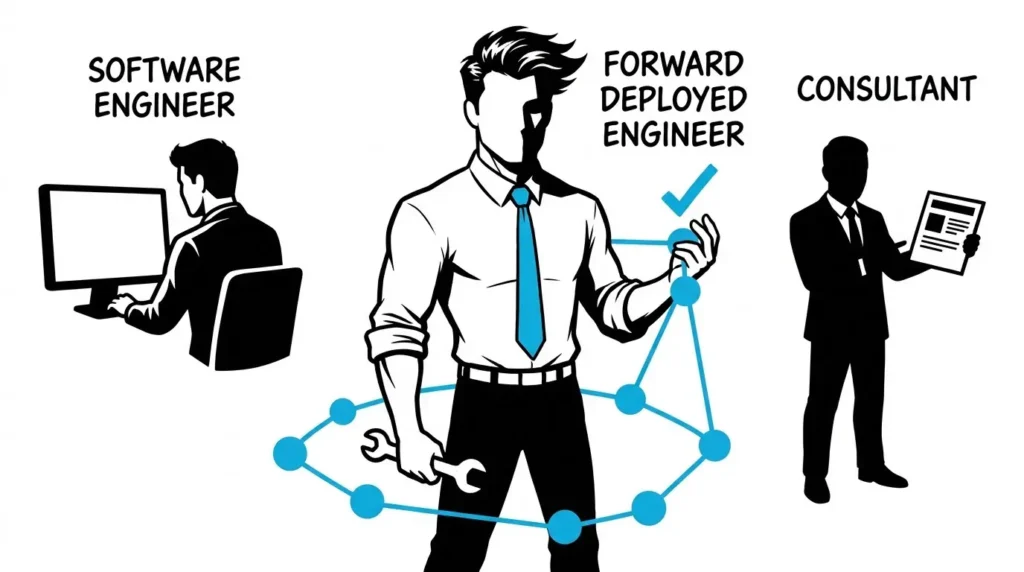
The FDE role gets confused with two others: the traditional software engineer and the management consultant. The clearest way to separate them is by where the person sits and what they are accountable for. A software engineer builds the product. A consultant advises on strategy. A forward deployed engineer does both, inside your operation, and owns the result.
| Forward Deployed Engineer | Software Engineer | Traditional Consultant | |
|---|---|---|---|
| Where they work | Embedded in the client’s daily operation, on-site or virtual | At the vendor, building the core product | Remote, with scheduled meetings and visits |
| What they deliver | A working, deployed system in the client’s environment | Features and code for a general product | Analysis, reports, and recommendations |
| Primary skill | Engineering plus business context | Engineering | Strategy and advisory |
| Speed to result | A working version in weeks | Tied to the product roadmap | Months before tangible output |
| Ownership | End to end, from design to live deployment | The codebase, not the client outcome | Handed off to the client to implement |
| Measured by | A live system, adoption, and business results | Shipped features | Deliverables such as decks and reports |
The practical takeaway is simple. When the hard part of a project is fitting AI to the way your business actually runs, the FDE is the role built for it. A software engineer sits too far from your operation to see that friction, and a consultant sits too far from the code to fix it.
What Does a Forward Deployed Engineer Do?
A forward deployed engineer turns a stalled or generic system into one that fits the business. The work spans the full lifecycle rather than a single handoff, which is why the day-to-day looks more like ownership than a task list.
Day to day, an FDE will:
- Map the real workflow. Learn how the team actually operates before writing any code.
- Connect the data. Wire up the client’s ERP, CRM, and other systems into one reliable source.
- Build in the client’s environment. Write production code and custom connectors that fit the existing stack.
- Ship a working version fast. Deliver an early build in weeks, then improve it on real feedback.
- Clear the blockers others miss. Catch authentication gaps, governance issues, and compliance snags before they stall the rollout.
- Train the team to own it. Leave the client able to run and extend the system without the consultant.
None of this happens from a distance. The reason the model works is that the same person who understands the business problem is the one writing the code to solve it, and they stay accountable until the system runs on its own.
Forward Deployed Engineer Salary and Demand
The forward deployed engineer is one of the best-paid roles in enterprise AI, and demand keeps climbing.
A forward deployed engineer earns a median of roughly $200,000 in total compensation, according to Levels.fyi. Base pay averages about $156,000, with top earners reaching $244,000 or more, per Glassdoor. The numbers climb far higher at frontier AI labs. Senior FDEs at companies like Anthropic and OpenAI clear $560,000 to $785,000, and principal-level pay tops $1 million, according to Perspective AI’s 2026 Forward Deployed Engineering Compensation Report, which is built on 1,200 compensation data points.
That pay reflects scarcity. Very few people can write production code, read a business, and sit with a client until the system works, so the ones who can command a premium.
Demand has followed the money. The New Stack called it AI’s hottest job as OpenAI and Google race to hire, and our own search-tracking shows interest in the term rising sharply through 2026. Palantir originated the model years ago. OpenAI formalized it into a dedicated deployment team in 2026, and the large cloud vendors have run equivalent roles for years.
For a business evaluating the role, the salary is not the point. The signal is. The market is paying a premium for the exact skill that turns a failed AI pilot into a working system.
When Do You Need a Forward Deployed Engineer? (And When You Don’t)
A forward deployed engineer is not the right answer for every project. The model earns its cost under specific conditions, and it is worth being honest about where it does not.
An FDE is worth it when:
- The system is complex and evolving. AI and data projects shift as the business learns, and an embedded engineer adjusts in real time.
- The integration is the hard part. When the blocker is connecting to legacy systems rather than the software itself, an FDE lives in that gap.
- Speed matters more than a perfect spec. If you need a working version in weeks, embedding beats a long discovery phase.
- Your team will inherit the system. An FDE builds while training your people to run it, so the knowledge stays in-house.
An FDE is often the wrong fit when:
- The system is stable and heavily governed. In environments with strict release and change-control processes, a fast embedded approach can add risk. Forbes has made this same point about traditional, tightly controlled systems.
- The work is a standard, off-the-shelf deployment. If the product installs cleanly and fits your process as-is, you do not need a custom build.
- You only need advice. For a strategy review with no engineering attached, a consultant costs less and fits better.
The rule of thumb is worth remembering when you scope your next project. Bring in a forward deployed engineer when the work is messy, technical, and close to how your business runs. For clean, standardized, or advisory work, a lighter option will serve you better and cost less.
How FreshBI Applies the Forward Deployed Engineering Model
FreshBI runs the forward deployed engineering model as its core delivery method. The team embeds with the client, ships early, and hands over a system the client owns outright.
Every engagement follows the same shape:
- Discovery and immersion. FreshBI studies the client’s processes, data, and key metrics before building anything.
- Rapid prototyping. Rather than months of documentation, the team ships a working dashboard or model early, so leaders have something real to test.
- Agile deployment. Once a prototype proves out, it moves to production with continuous client feedback.
- Continuous optimization. The system is monitored, retrained, and extended as the business changes.
This approach has delivered across finance, healthcare, manufacturing, and retail. Real-time dashboards give finance teams cash-flow clarity, and predictive models help manufacturers forecast demand and cut waste. What the projects share is the mechanism MIT identified as the missing piece: an engineer who sits inside the operation, owns the outcome, and closes the gap between a promising tool and a working system.
Bring the Forward Deployed Engineering Model to Your Business
Most AI projects stall at the same point. The tool is capable, but nobody bridges it to the messy reality of how the business runs. A forward deployed engineer closes that gap by building inside your operation and owning the result until it works.
FreshBI runs this model for AI consulting and business intelligence consulting. The team embeds with your people, ships a working version in weeks, and trains your team to run what it builds.
Book a call to talk through your project with FreshBI.
Frequently Asked Questions
What is a forward deployed engineer?
A forward deployed engineer is a technical expert who embeds with a client to build, customize, and deploy software inside the client’s own environment. They write production code, connect data sources, and stay until the system works.
How is a forward deployed engineer different from a software engineer?
A software engineer builds a general product from the vendor’s side. A forward deployed engineer works inside the client’s operation, adapts the system to their specific environment, and owns the deployment from design to live use.
How much does a forward deployed engineer make?
A forward deployed engineer earns a median of roughly $200,000 in total compensation (Levels.fyi), with an average base near $156,000 (Glassdoor). At frontier AI labs, senior FDEs clear $560,000 to $785,000, and principal roles top $1 million (Perspective AI, 2026).
Is forward deployed engineer a real engineering role?
Yes. A forward deployed engineer writes production code and builds real integrations. The role adds business context and client collaboration on top of core engineering, which is why it commands a premium.
What companies hire forward deployed engineers?
Palantir originated the role. OpenAI, Anthropic, Google, and Amazon Web Services now run forward deployed or equivalent roles, and enterprise AI and data firms use the model to get systems into production.
Do you need a forward deployed engineer for an AI project?
You need one when the hard part is integrating AI with how your business actually runs, when speed matters, and when your team will own the result. For standard, off-the-shelf, or advice-only work, a lighter option fits better.
Does FreshBI offer forward deployed engineering services?
Yes. FreshBI embeds forward deployed engineers to build and deploy AI and business intelligence systems inside your environment, then trains your team to run them.