
AI and Machine Learning
The Sales-to-Planning Handoff: Stop Making Customers Repeat Themselves
The Kickoff Call That Shouldn't Need To Exist
The deal closed on Tuesday. The rep understood exactly what the customer needed — the timeline pressure, the integration they were worried about, the internal stakeholder who almost killed the deal twice. By Thursday, that same customer is on a kickoff call with a planner asking, "So, tell me a bit about your business and what you're looking to do."
The customer answers politely. But something just quietly broke. Everything they told sales — the specifics, the nuance, the things that made this deal make sense — didn't make it across the gap. It's sitting in a CRM field nobody on the planning side is going to read in full, or in a rep's head, or nowhere at all.
Where the Context Actually Goes To Die
This isn't a training problem or a discipline problem. It's a structural one. Sales conversations produce understanding — a rep's live sense of what a customer means, not just what they say. Most systems can only capture what got typed into a form afterward, which is a lossy summary of a lossy summary.
- The notes are written for a human, not a system. "Wants faster reporting, mentioned Q3 board deadline" doesn't tell a planning agent anything it can act on.
- Nobody reads the whole history. A planner opening a new account has a CRM timeline to skim, not a conversation to understand — so they default to the intake questions they always ask.
- The handoff is the point of failure. Not the sales team, not the planning team — the seam between the two systems they each live in.
Multiply this by every deal you close, and "re-discovery" quietly becomes a permanent line item in every engagement's timeline — one nobody budgeted for, because nobody decided to include it. It just accumulates at the seam.
What Changes When It's One Agent, Not a Handoff
In an Agent Relay, the sales-to-planning handoff doesn't disappear because the planning step got faster. It disappears because there's no longer a second system for the context to fail to reach. The same agent that ran the sales conversation is the one drafting the plan — so nothing gets "handed off," because nothing left in the first place.
That's a different claim than "the CRM syncs better now." A better sync still means translating a live conversation into a form, then having someone else re-read the form and reconstruct their own understanding of it. One continuous agent skips both lossy steps: it already has the understanding, not just a record of one.
What This Actually Looks Like
- The conversation is the intake. Whatever the customer told the sales agent — priorities, constraints, the thing they mentioned once in passing — is already structured, not buried in a transcript.
- The plan drafts itself first. Before a human planner ever opens the account, there's already a real first draft built from what was actually said, not a blank template.
- The planner edits, not interviews. Their first conversation with the customer is "here's what I understand, what am I missing" — not "let's start from zero."
- Nothing requires the customer to perform their own context back to a new person. That's the whole point.
Why This Matters Beyond Speed
It's tempting to file this under "faster onboarding," and it is faster. But the real cost of the sales-to-planning gap isn't time — it's trust. Every time a customer has to re-explain something they already said, they learn, correctly, that your company doesn't actually share information internally. That's a strange thing to teach someone in their first week as a client.
It also removes a specific kind of dispute: the one where a customer says "that's not what we discussed with sales" and nobody can produce what was actually discussed, only what got typed into a summary field afterward. When it's the same agent on both sides of the handoff, there's no gap for that disagreement to live in.
Next In The Relay
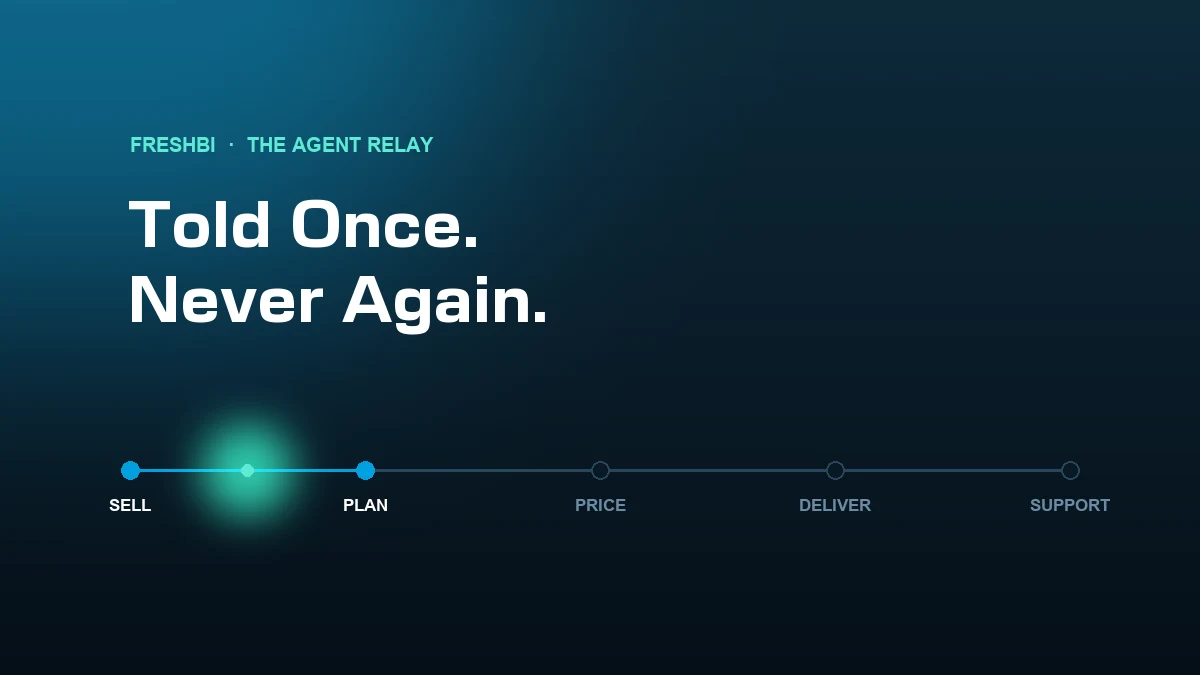
This is the second post in a series on the Agent Relay — one continuous AI carrying context across the whole customer journey instead of resetting at every handoff. Next: what it means for an agent to price work it didn't just estimate, but actually understands, because it was there for the conversation that shaped it.
If your planning team is still running a kickoff call to learn what your sales team already knew, that's not a planning problem. That's a relay with a broken leg.