AI and Machine Learning
Pricing & Proposals: The Quote That Already Knows What You Need
The Proposal That Reads Like It Was Written By Someone Else
The sales call was specific. The customer explained exactly what was breaking — a reporting cycle that took two weeks, an integration that kept silently failing, a board deadline that made "eventually" unacceptable. Three days later, the proposal lands in their inbox. It's polished. It's also generic: a standard tier, a standard scope, three bullet points that could describe almost anyone's engagement. Somewhere between the call and the document, the specifics got flattened into a template.
The customer notices. Not because the proposal is wrong, exactly — but because it doesn't sound like anyone was listening.
Why Proposals Default To Generic
This isn't laziness. It's what happens when the person writing the proposal wasn't on the call. They're working from a summary of a summary — a CRM note, a Slack recap, maybe a recording they didn't have time to watch — and building a document from the closest matching template, because that's the only version of "understanding the deal" available to them.
- The brief is a lossy compression of the conversation. Whatever didn't make it into someone's notes doesn't exist for the person pricing the work.
- Templates fill the gap. When the specifics are thin, the proposal reaches for the nearest standard package — because that's faster than reconstructing what was actually discussed.
- Pricing becomes a guess about scope, not a reflection of it. Line items get chosen to be safely broad, not accurately narrow — which is how you end up either overpriced for what they need or underscoped for what it'll actually take.
What Changes When The Proposal Comes From The Same Agent
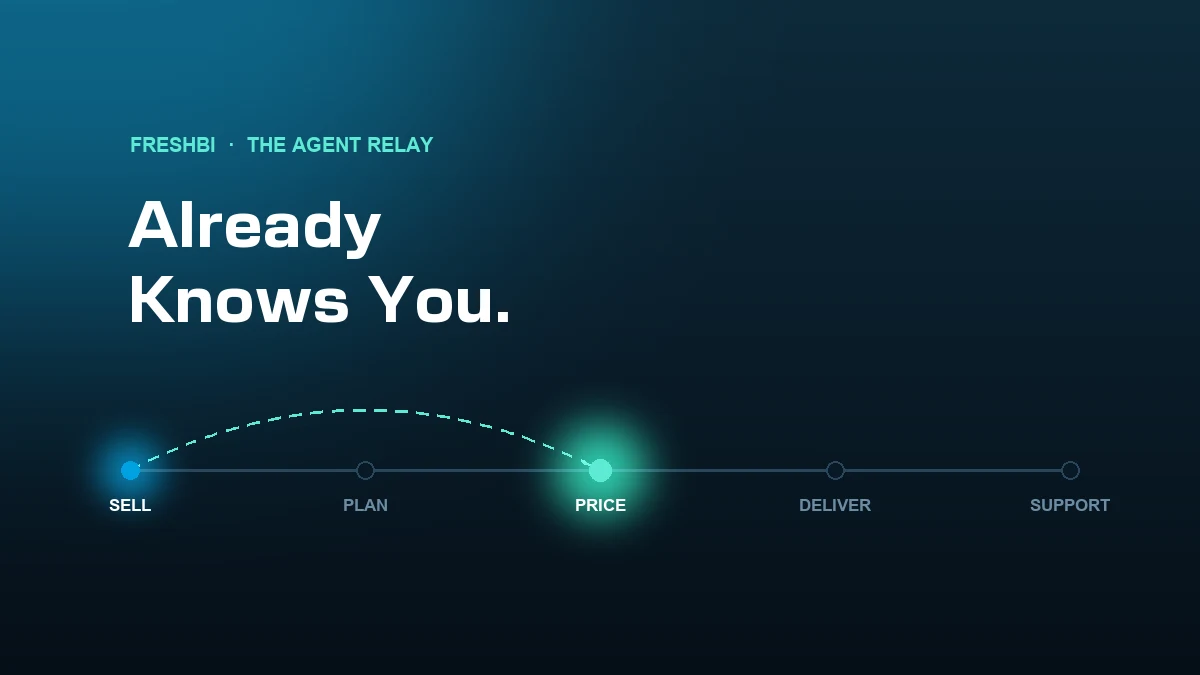
In an Agent Relay, the proposal isn't written from a brief — it's written by the same agent that had the conversation. Not a summary of what the customer said. What they actually said. The two-week reporting cycle isn't a bullet point that got added because it sounded relevant; it's the specific bottleneck the proposal is priced against, because it's the specific bottleneck that came up.
This is the same principle from the sales-to-planning handoff, one leg further down the relay: nothing gets asked for twice, and nothing gets guessed at either. The proposal is downstream of the actual conversation, not downstream of someone's notes about it.
What This Actually Looks Like
- Scope reflects what was said, not a category. If the conversation was about fixing one broken integration, the proposal doesn't quietly upsell into a full platform rebuild — and it doesn't undersell a genuinely bigger problem into a small fix, either.
- Line-item pricing traces to a real reason. Each piece of the quote maps to something specific the customer described, not a standard package assembled after the fact.
- The proposal arrives while the conversation is still warm. Because there's no re-interpretation step, there's no multi-day gap for momentum to cool off in.
- Revisions are corrections, not re-explanations. If something's off, the customer is refining a document that already understood them — not re-briefing a stranger.
Why This Matters Beyond Speed
A proposal is the first written artifact a prospect gets from you. If it reads generic, it quietly tells them the sales conversation was theater — that whatever they said was going to get filed away and replaced with a standard package regardless. If it reads specific, it does the opposite: it's proof, in writing, that the thing they said actually went somewhere.
There's a second, quieter benefit. When pricing is derived from the same source material as planning and delivery, there's no gap for a dispute to live in later. Nobody can say "that's not what we scoped" when the scope was never re-interpreted in the first place — it's the same record, the whole way through.
Next In The Relay
This is the third post in the Agent Relay series — one continuous AI carrying context across the whole customer journey instead of resetting at every handoff. Next: what happens after the proposal is signed, and why the delivery team assigned to the work is often already the right one, decided before the ink is dry.
If your proposals read like they were written by someone who wasn't on the call, that's not a writing problem. That's a relay with a broken leg.