
The Rail Schedule Nobody Showed the Load Planner
It's Thursday at 3 p.m., and the load planner is finished for the day. Tomorrow's loads are built. Every delivery window is met, the trailers are above 85% full, and the driver hours check out. By any measure the plan is good.
At the same moment, the yard supervisor is looking at a different screen. A rail crew will drop a string of cars first thing Friday morning. The goods lanes are already at 95%. Nobody told the planner, because the planner's job is trucks and windows, and the rail schedule lives somewhere else.
On Friday the cars arrive, the lanes overflow, and a very good load plan turns out to have been planned for half the problem.
Why This Keeps Happening
Nothing in that story is a mistake. The planner has correct numbers about orders. The supervisor has correct numbers about lanes. The rail schedule is correct too. Three accurate sources, in three places, and no one person holding all of them at 3 p.m. on Thursday.
That is not a discipline problem. Load planning and warehouse capacity are usually separate jobs with separate tools, so the warehouse only gets a say after the loads are already decided. By then the cheap fixes are gone.
What Changes When the Lanes Are Part of the Plan
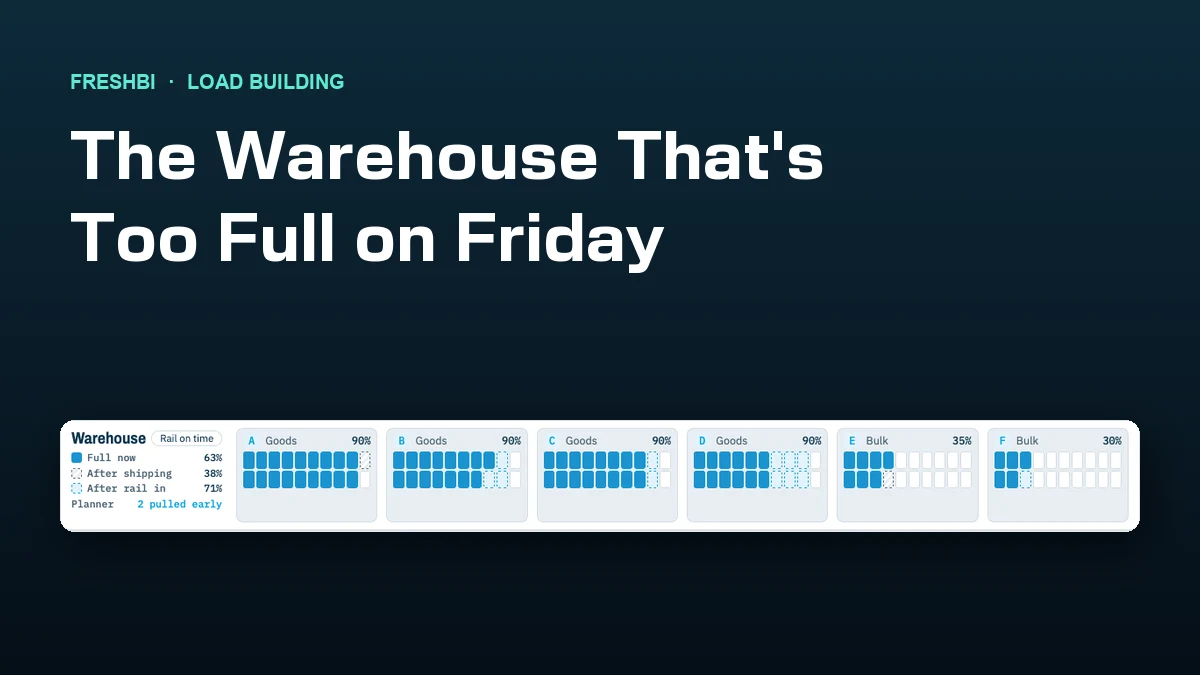
The fix is to give the plan three numbers for every warehouse lane, not one: how full it is now, how full it will be after the day's shipments leave, and how full it will be after the next rail delivery arrives.
With those on the table, two simple rules do most of the work. If a lane would go above 90% after the rail lands, the planner pulls forward orders that customers have said they will take early. If a lane would drop to 20% or below, it holds back orders that customers will take a day late. Only orders marked flexible are ever moved. Everything else ships when it was promised.
What This Actually Looks Like
- Each lane is drawn as blocks of pallets: solid for stock on hand, hatched for what leaves today, dashed for what rail is about to bring.
- A lane that is about to pass 90% turns amber on Thursday, before any car arrives.
- The planner pulls the early-delivery orders forward, and the trucks that took them are tagged with the order numbers, so nobody wonders why a load changed.
- Switch the rail to late and the opposite shows up. A lane runs low, and flexible orders wait a day to keep it stocked.
- Nothing ships until a person approves the plan, and any change can be undone.
The Trade-Off Is Visible, Not Hidden
Pulling an order forward is not free. It can mean a lighter truck today, or one more truck than the first plan used. That is a real cost, and the point is to show it next to the benefit. Compared with a full lane on Friday morning, an extra truck on Thursday is often the cheaper problem. But it is a trade, and a planner should be the one making it.
It also works in the other direction. An empty lane is a problem too. A warehouse that is always one shipment from running short has the same root cause as one that is always one rail drop from overflowing: nobody was looking at both sides at once.
Next in the Series
This is the first post in our load building series. You can see the idea running on a notional day on our warehouse throughput page, and the other version on our multi-stop load building page. The next post is about the other half of the plan: how many stops is too many on one trailer. Logistics teams can see the wider picture on our AI and BI for logistics page.
If your warehouse learns about the rail schedule on Friday morning, that's not a space problem. That's a plan that only saw half the picture.