
Every Stop on Time. Every Trailer Full.
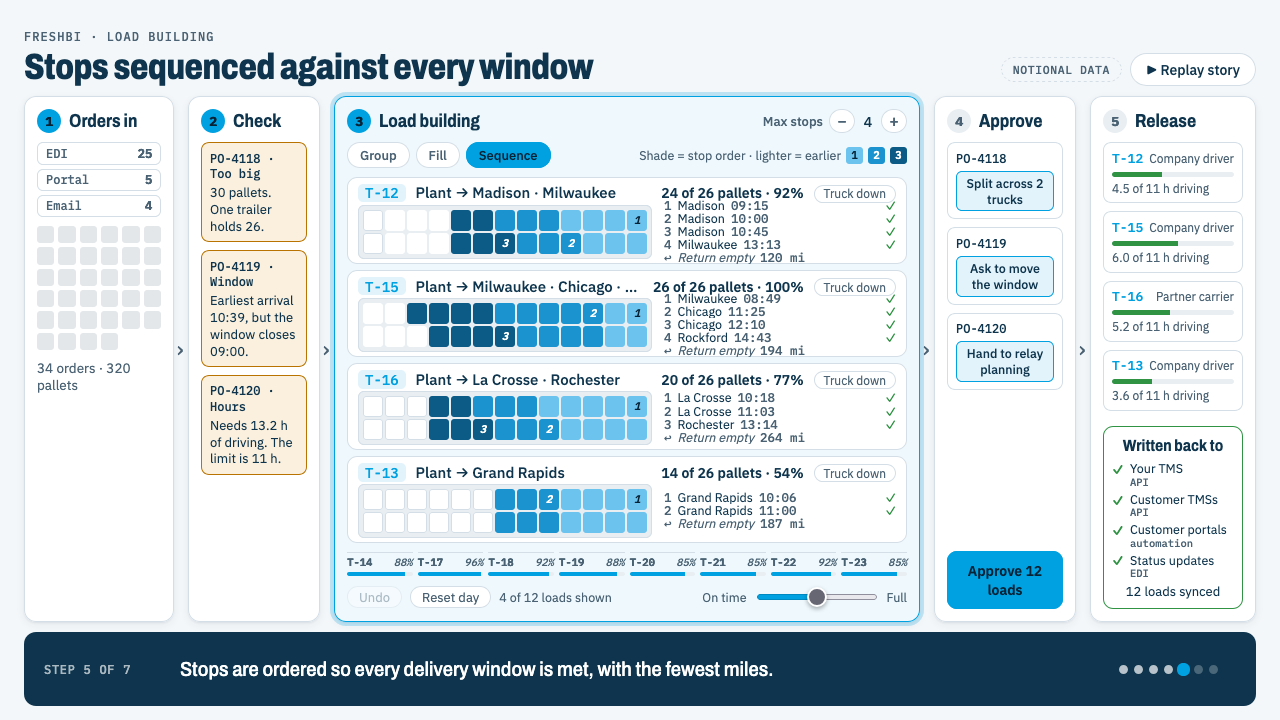
One trailer, three or four drops, and a delivery window at each. One AI-driven workflow groups the orders, fills the trailer and finds the stop order that meets every window with the fewest miles, so planners approve the exceptions instead of building routes by hand.
- 1Every window checked. Each stop is timed against its delivery window and the driver's hours before anyone is dispatched.
- 2Fewer trucks, fuller trailers. Allow more stops per trailer and the same orders need fewer trucks. Change the limit and see the trade-off.
- 3Exceptions flagged early. Orders that cannot go as entered are flagged, with a one-click way to resolve each.
01The problem
From routes built by hand to routes built before the shift
Sequencing stops by hand
- A planner groups orders from memory and a spreadsheet
- Stop order is a guess, checked against windows one by one
- Trailers leave half empty, or a window is missed
- Exceptions surface when a driver calls
Stops sequenced automatically
- Orders are grouped by where they are going
- Every stop order is tried, and the best one wins
- Pallet, weight, window and hours rules are checked on every load
- The planner sees only the few that need a decision
02The workflow
From the first order to a released load
Five steps, one record. The heaviest work happens in the middle, where orders become loads with stops in order.
- Orders in One clean list
- Check Flags what cannot go as entered
- Load building Group, fill and sequence the stops
- Approve You decide the exceptions
- Release Drivers, your TMS and customer systems
03See it live
Watch a day of loads, then change the stops
The workflow plays on its own. Then change the number of stops per trailer. In this notional day, limiting trailers to 2 stops needs 16 trucks at 65% full on average. Allowing 4 stops needs 12 trucks at 86%.
Notional orders, lanes, drivers and distances. The planner uses plain arithmetic (an insertion heuristic and exact stop ordering), not a language model, and it does not guarantee the best possible plan. Driver hours shown are driving hours against an 11-hour limit. No load is dispatched and nothing is written to a TMS.
04Your rules
It plans inside the limits you already run
Rules are settings, not custom code, and a planner can change them and watch the plan re-solve.
-
Stops per trailer
Set the maximum number of drops per load and see the effect on trucks and fill.
-
Delivery windows
Each stop is timed against its window, with tight and late stops called out.
-
Stop order
Every order of stops is tried, and the one that meets each window with the fewest miles wins.
-
Driver hours
Driving hours are checked against the limit, and long hauls are handed to relay planning.
-
Customer rules
Deliver-before times and ride-alone requests are respected on every load.
-
On time or full
One dial trades shipping on time against filling the trailer.
Frequently asked questions
What is a multi-stop load?
How many stops per trailer is right?
How does it choose the stop order?
Does it replace our transport management system?
Where do the orders come from?
What happens to orders that cannot be loaded as entered?
Can planners override the plan?
What do we need to get started?
Ready to see your stops sequenced before the day starts?
Book a free consultation and see how your own orders would load.