
Intermodal & Drayage Logistics

Turn Empty Returns Into Paid Backhauls.

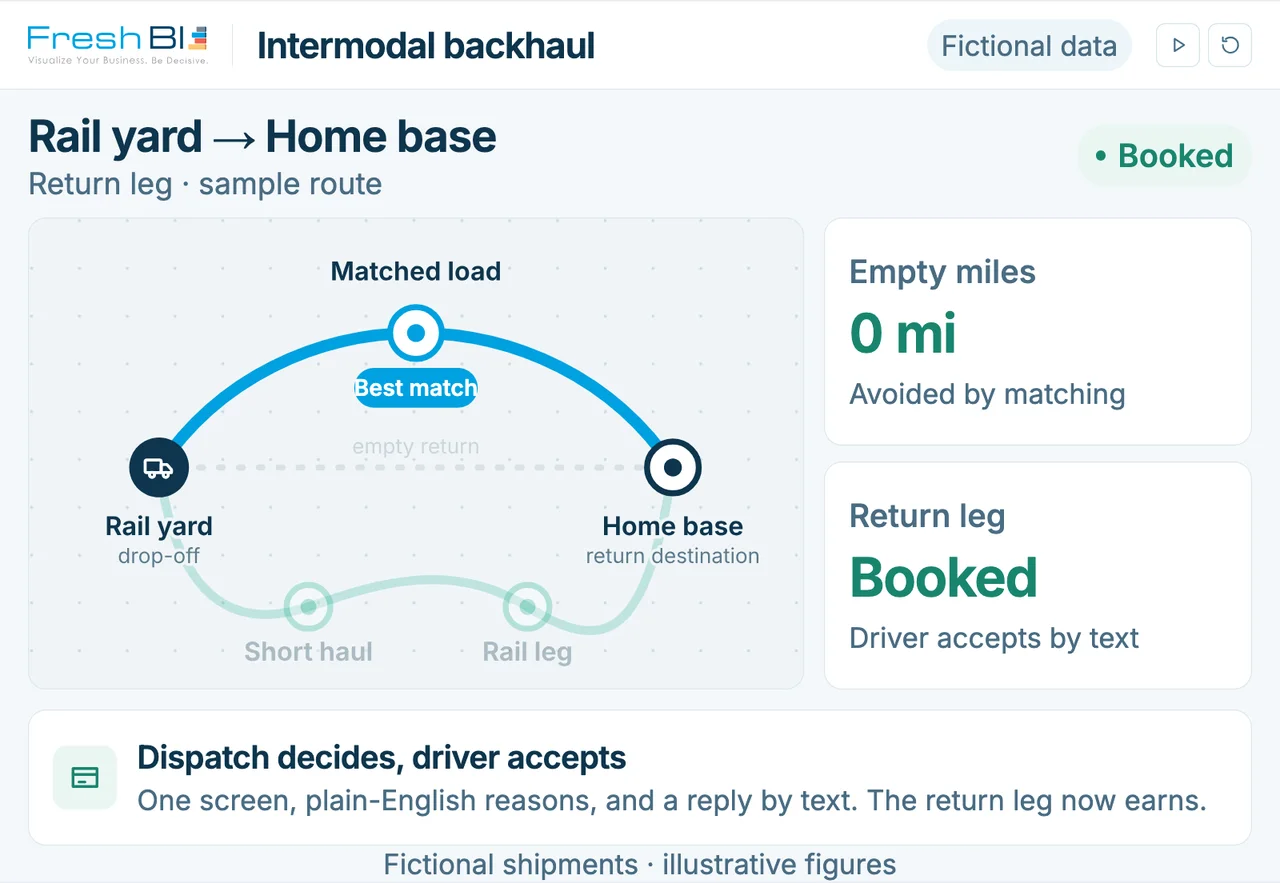
After every drop, a truck heads home empty. One AI-driven platform finds the best return load, by truck, rail or barge, and puts the offer in front of dispatch in seconds, so deadhead miles become margin and savings.

  1. 1Fewer empty miles. Every drop is matched against live loads and capacity, including multi-mode options.
  2. 2Stronger margins. Carriers and 3PLs earn on the return leg while shippers see lower freight costs.
  3. 3No extra work for anyone. Drivers confirm by text, dispatch decides from one screen, and shippers get a short update.
A return leg matched to a backhaul, with a multi-mode alternative

Trusted by more than 300+ companies around the world

  • City-of-Vancouver
  • LOreal
  • British-Columbia
  • Government-of-Manitoba
  • Disney
  • Nestle
  • John-Deere
  • Scotiabank
  • Wells-Fargo
  • Chevron
  • FedEx
  • Walmart
  • ATT
  • freshbi-business-intelligence-data-analytics-ai-kaiser-permanente-update-2

01The problem

Every empty return is paid for twice

  1. Problem 1
    A person surrounded by question marks and unreadable charts

    Deadhead miles burn fuel and time

    A truck that drops a container at a rail yard or port often faces a long, empty run home, with the fuel, hours and wear all unpaid.

  2. Problem 2
    Sketch of a stack of data on fire

    Return loads are found by hand

    Dispatch searches load boards, makes calls and checks spreadsheets, and the best matches are gone before anyone sees them.

  3. Problem 3
    Sketch of a person driving blind

    Shippers never see the savings

    Without a clear record of return-leg decisions, neither side can show what optimization is worth, or ask for it with confidence.

The cheapest mile is the one that earns on the way back.

02The solution

From drop-off to paid return in one flow

One platform reads each drop, finds compatible loads and multi-mode loops, explains its reasoning, and carries the decision through to booking and reporting.

  1. Your data Everything you already run
    • TMS
    • GPS & telematics
    • Rail schedules
    • Load marketplaces
    • Carrier capacity
  2. One live model Every truck, container and lane
  3. AI matching Backhauls and multi-mode loops
  4. Dispatch decides One screen, plain-English reasons
  5. Return leg earns Margin for you, savings for the shipper

03Under the hood

Four capabilities, one platform

Sketch of several business systems feeding one data platform
One source of truth

A live model of every truck, container and lane

Equipment, locations, schedules and loads sit in one continuously updated model, so every screen and every recommendation works from the same truth.

  • Understands intermodalContainer types, equipment compatibility and modal handoffs are built in as first-class objects.
  • Real-time inputsYour TMS, GPS, rail schedules and load sources arrive in one place.
  • Everything flows backPaperwork and updates are written back to the model, so nothing is rekeyed.
Sketch of an AI assistant finding a return load for a truck
AI matching

Backhaul and triangulation matching in seconds

When a driver confirms a drop, the platform reads location, equipment and availability, then searches for the best way home.

  • Direct backhaulsCompatible loads heading the way the truck needs to go.
  • Multi-mode triangulationWhen a straight backhaul is not the best answer, a short haul, a barge or a rail leg can close the loop.
  • Reasons you can trustEach option shows capacity, timing, a fuel and emissions estimate, compliance checks and a plain-English rationale.
Sketch of a dispatcher and an AI assistant reviewing fleet options
Decisions

Simple for everyone in the chain

Each person gets the view that suits their job, and nobody has to learn a new tool to take part.

  • Drivers reply by textConfirm a drop with a photo of the proof of delivery and accept a match with a message.
  • Dispatch compares and simulatesReview options side by side and see the effect on client cost and your own revenue before choosing.
  • Shippers stay informedA short email or text tells them the move is on track and the return leg is optimized, with no action needed.
Sketch of a manager reviewing charts with an AI assistant
Reporting

Proof of every mile saved

Operations and account teams see what optimization delivers, move by move and across the network.

  • Empty miles and utilizationTrack deadhead and load utilization by lane, equipment and customer.
  • Savings per clientShow shippers what each move saved, in a form they can read in seconds.
  • Emissions estimatesReport the sustainability gain from every avoided empty mile.

04See it live

Explore the live fleet dashboard

An interactive control tower with sample data, shown here with a courier scenario: live location, status, handoff records and charges for every move on one screen. A demo built around backhaul matching is coming soon.

Open the dashboard full screen ↗

05The result

What it does for the business: Fewer empty miles. Stronger margins. Lower freight costs.

What it does for the business

  1. Fewer empty miles.
  2. Stronger margins.
  3. Lower freight costs.

Carriers and 3PLs earn on the return leg, and shippers see lower effective freight costs and better visibility, without managing backhauls themselves.

View case studies

06How we deliver

From first call to paid return legs

  1. 1
    Three people choosing a path labelled plan, development, adoption and return on investment
    Step 1

    Discover & Define

    We map your lanes, equipment, return-leg patterns and the KPIs you run and bill by.

  2. 2
    Sketch of business systems connecting into a single dashboard
    Step 2

    Integrate & Configure

    We connect your TMS, GPS and telematics, rail schedules and load sources into one live model.

  3. 3
    Sketch of a team building a data system
    Step 3

    Build & Customize

    We tune the matching rules, multi-mode options and alerts to your network, then build your dashboards.

  4. 4
    Sketch of a team being supported to use their new data assets
    Step 4

    Empower & Support

    We train dispatch, drivers and account teams, and keep refining the system with you.

07Who it helps

One platform, the right view for everyone

Everyone works from the same live record, in the way that suits their job.

  • Drivers and owner-operators

    Confirm a drop and accept a return load by text, with no new app to install.

  • Dispatch and coordination

    See ranked return options for every truck and book the best one in a click.

  • 3PL and fleet operations

    Watch utilization, margin and savings across clients and lanes.

  • Shippers and procurement

    Get lower effective freight cost and clear updates without managing the details.

08Beyond intermodal

Built for any fleet that wants every mile to earn

The same platform adapts wherever trucks, containers and capacity move.

  • Drayage and port logistics

    Match the return run from every terminal and rail ramp.

  • Private and shipper fleets

    Fill the backhaul on your own trucks, not just the outbound.

  • Freight brokers and 3PLs

    Add margin on returns and report the savings to clients.

  • Rail and multi-mode networks

    Connect truck, rail and barge legs into one efficient loop.

  • Want an AI agent for your fleet?

    Meet the Empty Leg Eliminator, a conversational agent for fleet optimization.

    Learn more →
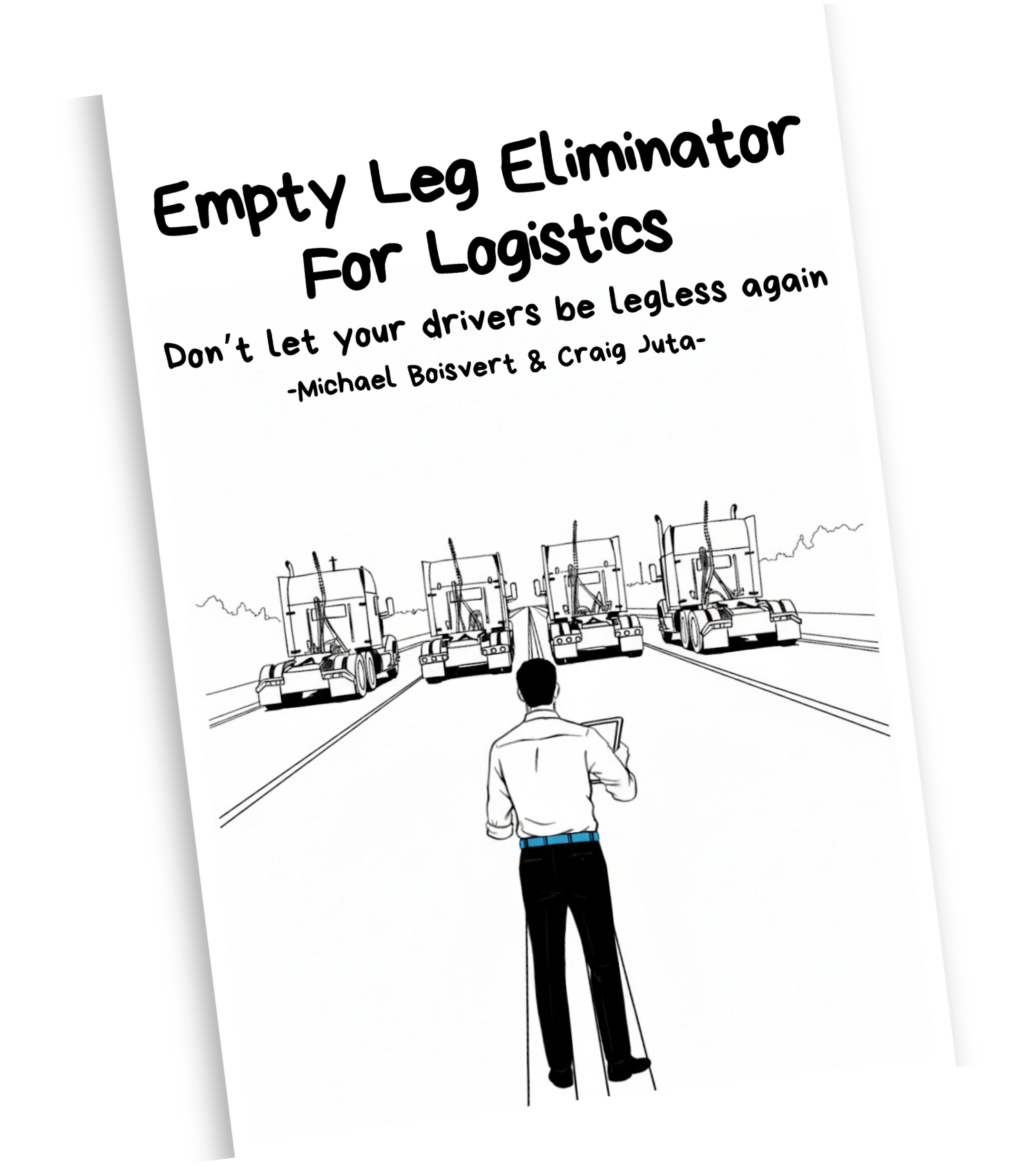
Free e-book

Download the “Empty Leg Eliminator” e-book

Discover strategies to fill empty miles and recover profit on every trip.

Empty Leg Eliminator e-book cover

09Pricing

No surprises, just clear value

Most popular

Plan Annually

$77,000/year

We bring your 12-month BI vision to life with instant scalability.

Get started

Plan Monthly

$7,000/month

A setup process and a straightforward monthly subscription fee.

Get started

Plan Big

Custom

You dream it, we build it.

Get started

Every plan includes

  • Embedded business consulting
  • Ontology 1st design
  • Data centralization and governance
  • Agentic use case design and deployment
  • Beautiful dashboards
  • Data platform architecture
  • Data platform implementation
  • Team enablement in AI and BI
  • Process design and automation
  • Data modelling in Excel

Frequently asked questions

What is an empty leg, and why does it matter?
An empty leg, or deadhead, is any run where a truck travels without paid cargo, typically the trip back after a drop-off. Fuel, driver time and equipment wear are spent with nothing earned, so reducing empty legs raises margin directly.
How does the platform find return loads?
It reads the driver’s location, equipment and availability, then searches your TMS, carrier capacity, rail schedules and load sources for compatible loads heading the right way.
What is triangulation?
When a direct backhaul is not the best answer, the platform can build a multi-mode loop instead, for example a short truck haul, a barge or rail leg, and then a final pickup, and compare it against the direct options.
Do drivers need to install an app?
No. Drivers confirm a drop with a photo of the proof of delivery and accept a match by text message.
Does it replace our transport management system?
No. It connects to your TMS and other sources and adds matching and optimization on top, with no rip and replace.
How does it explain its recommendations?
Each option shows capacity, timing, a fuel and emissions estimate and compliance checks, along with a plain-English reason for the match, so dispatch can see why it was suggested.
Who sees the savings?
3PLs and fleets can report the savings from each move to their customers, and shippers receive a short update when the return leg is optimized.
Is our data secure?
Your data is safe with FreshBI’s top-tier encryption, secure access controls and compliance with industry-leading data protection standards.

Ready to put every return leg to work?

Book a free consultation and see how your own network’s empty miles could earn.

See It On Your Network