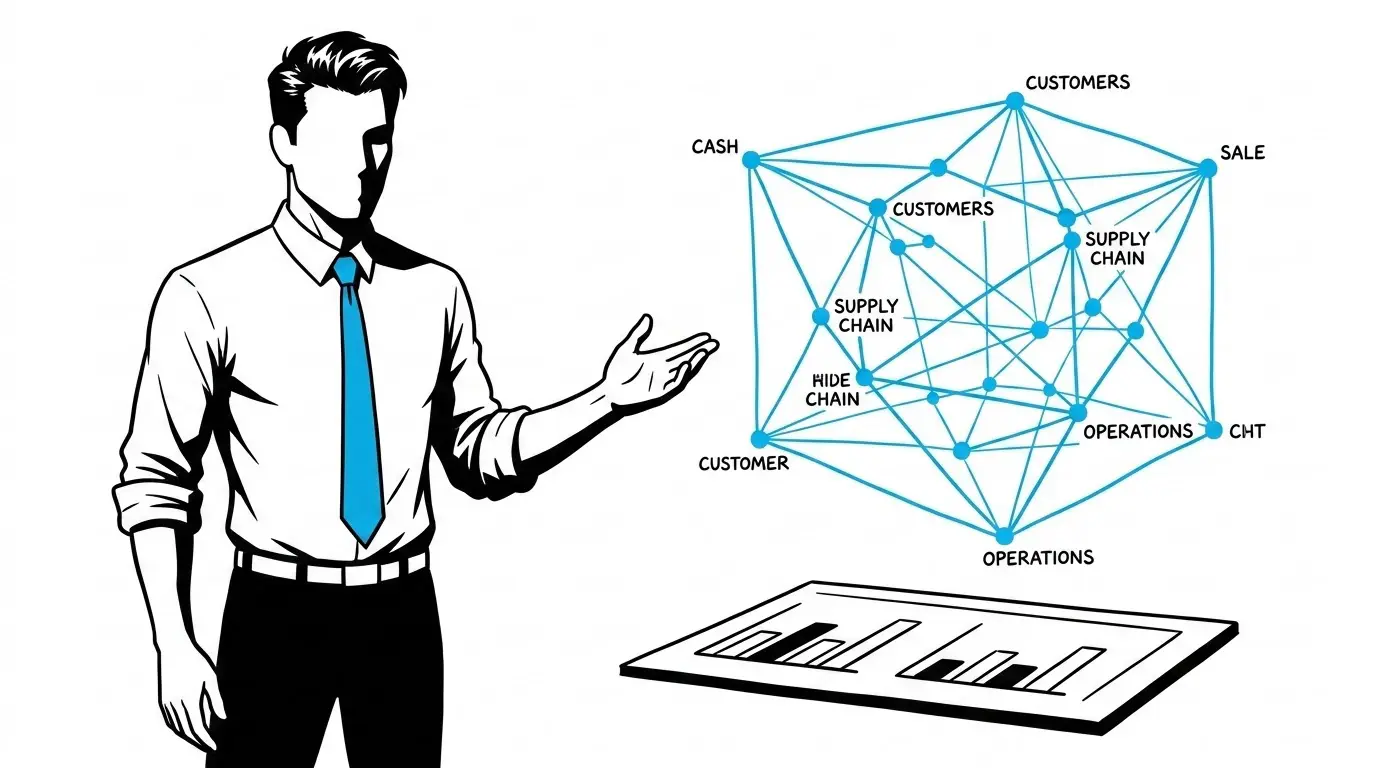
A digital twin for business is a living, data-grounded model of how your organization actually operates, one that lets AI reason over real processes, real financials, and real relationships instead of a stale export. It connects live data from your core systems into a single model that reflects what is happening now and what is likely to happen next.
A business digital twin is built from three layers:
- Governed data — clean, validated, version-controlled inputs from your ERP, CRM, and financial systems.
- A semantic layer — the translation of technical fields into business concepts everyone understands.
- A business ontology — the structure that encodes how entities relate: customers to contracts, contracts to revenue, revenue to cost centers.
Your CFO heard “digital twin” in a board presentation last quarter and now wants to know whether it applies to the business or just to factory equipment. Fair question. The term started on the manufacturing floor, where engineers built virtual replicas of jet engines and turbines to predict failures before they happened. The business reading is different, and this guide breaks down the business definition, explains what separates a digital twin from the dashboards you already have, walks through what it takes to build one, and gives you concrete examples of what executives can actually do with it. No engineering jargon. No IoT sensor talk. Just the business meaning, the architecture behind it, and where to start.
Table of Contents
- What a digital twin means for your business, not your factory
- From static reports to a living model
- What a business digital twin is built from
- A business digital twin in practice
- Digital twin vs. the terms it gets confused with
- Where to start
- Frequently Asked Questions
What a digital twin means for your business, not your factory
A business digital twin is a continuously updated virtual representation of your organization’s operations, finances, and decision logic. It connects live data from your ERP, CRM, financial systems, and operational tools into a single model that reflects what is happening right now and what is likely to happen next.
The engineering origin matters for one sentence: the concept traces back to NASA’s Apollo-era practice of maintaining physical twins of spacecraft for simulation and monitoring. That version of the digital twin still dominates search results, with Siemens, NVIDIA, and Azure Digital Twins owning the conversation around physical-asset replicas.
The business reading of the term
The business reading is different. Instead of modeling a machine, you model the organization itself. Revenue flows, customer journeys, supply chain nodes, headcount allocation, vendor dependencies. All of it connected, all of it live. Research from the Wharton School’s Mack Institute for Innovation Management reinforces this shift, describing cross-industry frameworks that unify ERP, spatial, environmental, and ML data into continuously learning enterprise twins, where the value comes from improved decisions, reduced risks, and operational efficiencies the twin enables.
When someone in your AI strategy meeting says “digital twin,” this is the version they mean. Not a 3D rendering of a warehouse. A living model of the business that gives AI something real to reason over.
From static reports to a living model
Most executive teams run on reports that describe what already happened. Monthly close. Quarterly review. A dashboard built three months ago that nobody updated. That is the static regime, and it creates a gap between the moment a condition changes in the business and the moment a decision-maker finds out about it.
What dashboards miss
Dashboards answer backward-looking questions well. What were last quarter’s revenues by region? How many support tickets closed in March? But they struggle with the questions that actually drive action. Where is cash going to be tight in six weeks? Which supplier delay is about to cascade into three missed commitments?
A business digital twin closes that gap because it holds both the current state of every connected system and the relationships between those states, which means it can project forward. When your accounts receivable data connects to your supply chain commitments in a single model, the twin surfaces the downstream impact of a delayed payment before it ripples through operations.
Decisions, not static dashboards
This is the core shift: you move from consuming reports to interrogating a model. The twin does not just display numbers. It encodes how entities in your business relate to each other, so when one variable changes, the model shows you what else moves. That is what lets AI deliver foresight instead of hindsight. And it is why organizations serious about AI-driven decisions are investing in digital twins as the foundation rather than bolting AI onto disconnected dashboards.
Market Research Future reports that global enterprises spent more than USD 8 billion on IoT-enabled digital twins for smart manufacturing in 2024. The enterprise and business-process side of that spend is growing even faster, because executives recognize that AI without a grounded model is AI without context.
What a business digital twin is built from
A digital twin does not materialize from a single tool purchase. It requires three foundational layers working together: governed data, a semantic layer, and a business ontology.
Governed data as the raw material
The twin needs trustworthy inputs. That means data from your source systems, cleaned, validated, and version-controlled. If your ERP says one thing about inventory and your warehouse management system says another, the twin inherits that conflict. Governance is not optional. A twin built on dirty data produces confident wrong answers, so the raw inputs have to be cleaned and reconciled before they ever enter the model.
The semantic layer and business ontology
Raw data alone is not enough. A semantic layer translates technical database fields into business concepts that executives and AI models can both understand. “Rev_Q3_NA” becomes “Q3 North America Revenue.” That translation layer makes the twin usable across functions without requiring everyone to speak SQL.
Sitting above the semantic layer is the business ontology. The ontology encodes how entities in your business relate to each other: customers to contracts, contracts to deliverables, deliverables to resources, resources to costs. It is the structural backbone that turns a collection of data points into a connected model. Understanding the relationship between data architecture patterns and ontology design matters here, because the ontology determines what the twin can actually represent and reason about.
The twin is built on the ontology. Without it, you have a data lake with a nice front end. With it, you have a model that understands cause and effect across your organization.
A business digital twin in practice
Theory only goes so far. Here is what a digital twin actually looks like in two common executive contexts.
The cash flow twin
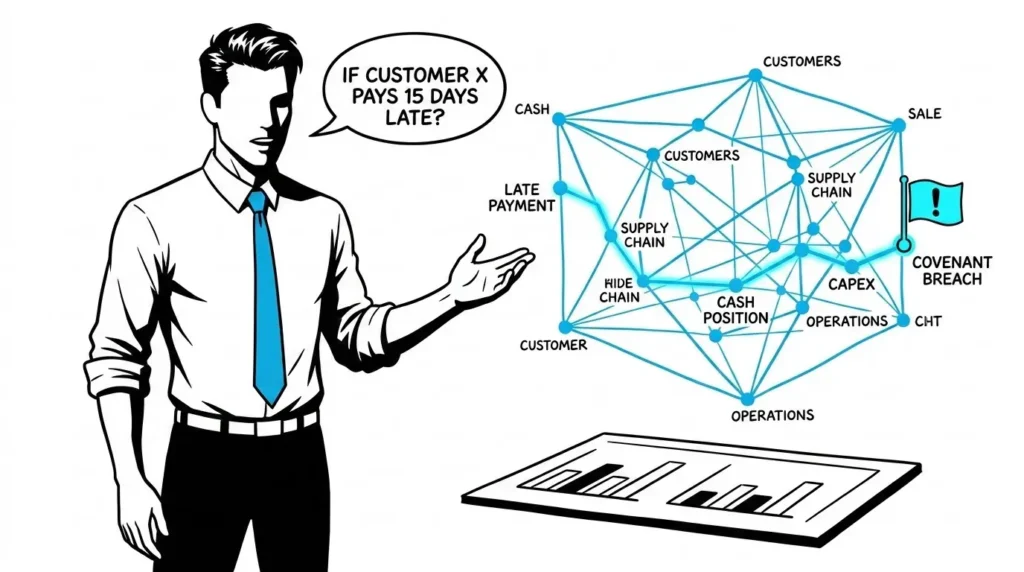
A CFO connects accounts receivable, accounts payable, revenue recognition schedules, and credit facility terms into the twin. The model reflects the current state of cash across every entity in real time. Instead of waiting for a weekly treasury report, the CFO asks the twin direct questions: “If Customer X pays 15 days late and we accelerate the Q2 capital expenditure, do we breach our covenant?” The twin runs the scenario against live data and shows the projected impact, because it holds the relationships between those financial entities, not just the numbers.
The operations twin
A COO connects order management, logistics, supplier lead times, and workforce scheduling. The twin models the current operational state and surfaces risks before they become problems. “Which three facilities are most exposed if our primary resin supplier misses next week’s shipment?” That question requires the twin to trace relationships across procurement, production scheduling, and inventory buffers. A dashboard cannot answer it because a dashboard does not hold those connections.
These are not hypothetical features. They are the practical outcome of connecting governed data through an ontology into a single living model. For teams that want the full operator-level treatment of how to build and maintain this kind of model, Truzer’s operator guide to digital twins covers the deep technical architecture. Truzer is FreshBI’s sister brand, and their guide picks up where this executive overview leaves off.
Digital twin vs. the terms it gets confused with
Executives hear “digital twin” alongside several related terms. The distinctions matter because confusing them leads to misaligned investments.
Digital twin vs. simulation
A simulation runs a scenario against a fixed set of assumptions. You set the inputs, run the model, and get an output. A digital twin is continuously connected to live data, so the “inputs” update themselves. You can run simulations inside a twin, but the twin itself is the always-current model that makes those simulations grounded in reality instead of last month’s assumptions.
Twin vs. dashboard and data warehouse
A dashboard visualizes data. A data warehouse stores it. Neither one encodes how business entities relate to each other or projects forward. The digital twin sits on top of your data infrastructure and adds the relational logic and temporal awareness that dashboards and warehouses lack.
A business ontology is sometimes confused with the twin itself, but they serve different roles. The ontology is the structural definition of entities and relationships. The twin is the living instance of that structure populated with real-time data. You build the ontology first. The twin runs on it.
Where to start
The instinct is to start with the twin. Buy a platform, connect everything, see the model. That sequence fails because you end up with connected data and no structural logic to make sense of it.
Ontology first, then architecture
Start with the ontology. Map your business entities, their relationships, and the decisions those relationships support. Which entities matter most? How do they connect? What questions does your executive team need the model to answer? That mapping exercise comes before any technology decision.
FreshBI’s approach follows Ontology 1st Design, where the business logic gets defined before the data architecture takes shape. From there, the Medallion Architecture (Bronze, Silver, Gold, Platinum) governs how data flows from raw ingestion through validated, enriched, and decision-ready layers. The ontology tells the architecture what to build. The architecture gives the twin clean, governed data to run on. That sequence produces a twin that reflects your actual business instead of a generic template.
Practical first steps for executive teams
Pick one high-value decision domain. Cash flow forecasting. Supply chain risk. Revenue operations. Map the entities and relationships in that domain. Govern the data sources that feed it. Build the ontology for that scope. Then expand. A twin that covers one critical decision area well is worth more than a twin that models the entire organization poorly.
For teams ready to build the living model behind their AI, Truzer (FreshBI’s sister brand) provides the operational infrastructure that turns an ontology into a continuously running digital twin.
Try Truzer to build the living model behind your AI. Or book a call with FreshBI to design the ontology and data foundation it runs on, or see pricing.
Frequently Asked Questions
What is a digital twin in business terms?
It is a living, data-grounded model of how your organization operates: revenue flows, customer journeys, supply chain nodes, and the relationships between them, updated from live data so AI can reason over real operations.
How is a business digital twin different from a dashboard?
A dashboard displays what happened. A digital twin holds the current state of every connected system plus the relationships between them, so it can project forward and answer “what happens next” questions a dashboard cannot.
What is a digital twin built from?
Three layers: governed data as the raw material, a semantic layer that translates fields into business concepts, and a business ontology that encodes how entities relate. The twin is built on the ontology.
Is a digital twin the same as a simulation?
No. A simulation runs against fixed assumptions. A digital twin is continuously connected to live data. You can run simulations inside a twin, but the twin itself stays current with reality.
How long does it take to build a business digital twin?
A focused twin covering one decision domain, like cash flow or supply chain risk, can be delivered in weeks. The timeline depends on data access and how quickly your team agrees on the entities and relationships that matter. Starting narrow beats modeling the whole organization at once.
Is a business digital twin only for large enterprises?
No. Mid-market companies benefit by scoping to a single high-impact decision area rather than attempting a full-organization model. The value comes from connecting the right entities for the decisions you make most, which keeps cost and complexity in check.