AI and Machine Learning
The 7-Question AI Vendor Evaluation Framework: How to Choose an Enterprise AI Partner

Your last two AI vendor conversations ended the same way. A polished deck. A vague promise about “transformative outcomes.” A quote that made your procurement team wince. You left both calls knowing less than when you dialed in. The board wants a recommendation. You still do not have a defensible AI vendor evaluation framework for picking an ai consulting firm that will survive the first budget review.
This guide gives you the framework. Seven questions, built for CFOs, COOs, CIOs, and CTOs at mid-market and enterprise companies. Take it into your next executive meeting. Hand it to your evaluation committee. Use it to separate the firms that talk from the firms that ship.
Table of Contents
- The decision is the easy part. Choosing the firm is the hard part
- Why most AI vendor evaluations fail
- The 7 questions every evaluation must answer
- Platform vs. pure consulting: the question that changes everything
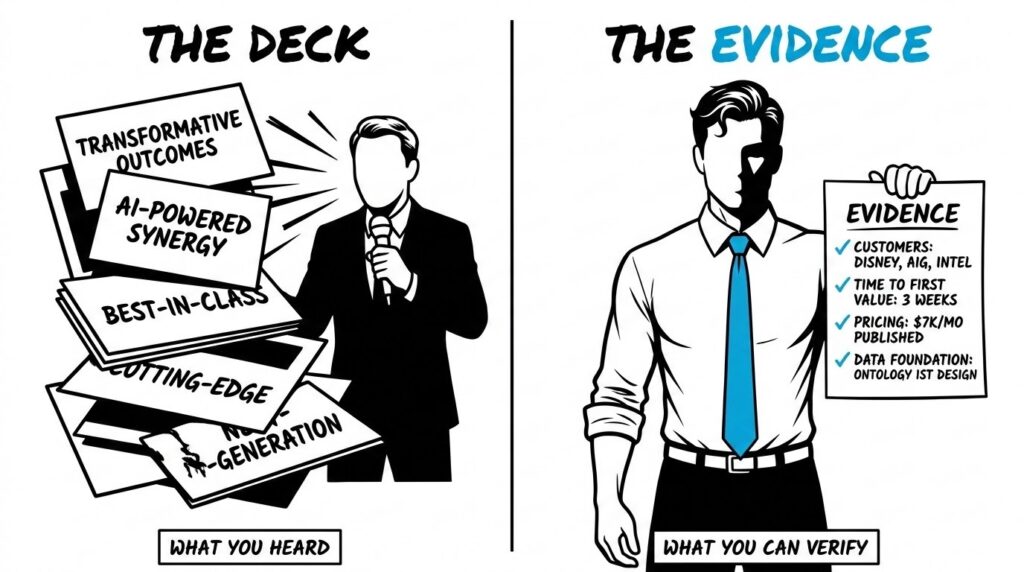
- What to ignore in vendor decks
- A case from our work: a vendor switch
- The 60-minute conversation that should decide it
- The verdict and your next step
- Frequently Asked Questions
The decision is the easy part. Choosing the firm is the hard part
Your team lacks bandwidth. Your data has gaps. You need someone who has done this before. That conversation takes one meeting.
Choosing which firm is where most AI projects fail. Pick the wrong partner, and six months later you are staring at a prototype nobody uses, a bill nobody approved, and a board that no longer trusts the next AI pitch.
If you have already read the case for BI consulting, you know the argument for outside expertise. This is the next step. It assumes you are already convinced you need a partner. The question now is which one.
Every credible firm should answer all 7 questions below without hedging. If a vendor dodges even one, that tells you something. If they answer all 7 with named evidence, that tells you more.
Why most AI vendor evaluations fail
Three patterns repeat.
Evaluating capability instead of fit. Every vendor on your shortlist can build a model. Every vendor has a case study. Capability is table stakes. What matters is whether the vendor’s delivery model, data methodology, and support structure fit your reality. A firm that deploys beautifully for a 50-person startup will struggle inside a 5,000-person enterprise with legacy ERP and compliance requirements.
The deck wins over the track record. Vendor decks are designed to impress, not inform. The firm with the best slides often has the weakest post-sale support. Ask for reference calls. Ask for named customers. Ask what happened at month six, not just month one.
Nobody asks the platform question. Most buyers ask about the consulting but never the platform underneath. A consulting-only engagement hands you a custom one-off. A platform-backed engagement hands you something that improves over time.
The 7 questions every evaluation must answer
Print this section. Bring it to the vendor call. Score each firm on a 1-to-5 scale. The firm that answers all seven with specifics wins. The firm that hedges on three or more loses.
1. What is your platform underneath the consulting?
A consulting firm without a platform delivers a bespoke artifact. When the engagement ends, the artifact starts decaying. Nobody maintains it. Nobody improves it. It sits in your environment, frozen at the moment the consultants walked out.
A platform-backed firm delivers something different. The work product connects to a living system that gets better as other clients use it, as the vendor invests in R&D, and as the underlying data architecture evolves. When you ask FreshBI this question, the answer includes Truzer (FreshBI’s sister brand), the AI Integrator that grounds FreshBI’s AI agents in a live business ontology. The platform answer means your engagement is not a one-off.
2. What is your time to first value?
If the answer is “6 to 12 months,” walk. Your board will lose patience by month four. Your champion will lose credibility by month three.
FreshBI’s benchmark is a 3-week v0.9 sprint. A working deliverable, not a requirements document, inside 21 days. The sprint is not the full engagement. It is proof that the firm can ship, not just plan. Any credible firm should name a specific time-to-first-value number. If they cannot, they have not done this enough times to have a reliable process.
3. What is your data foundation methodology?
AI without a clean data foundation is a liability. The model hallucinates. The outputs contradict your financials. The CFO loses trust in the entire initiative.
FreshBI’s answer is Ontology 1st Design paired with Medallion Architecture. The data layer gets built and validated before any model touches it. For AI integration services on FP&A specifically, the data foundation determines whether the AI output matches your general ledger or contradicts it.
4. Who is accountable when something goes wrong?
A data pipeline breaks. A model drifts. A dashboard shows the wrong number to the CEO. Who picks up the phone?
FreshBI assigns named individuals to every engagement. Not a support queue. Not a chatbot. A person with a name, a response SLA, and accountability for your outcome. If a vendor cannot name the person who owns your account before you sign, they will not name one after.
5. What does your pricing look like, transparently?
The fastest disqualifier: ask for pricing and receive “it depends” with no follow-up. Every engagement has variables. Credible firms publish a baseline.
FreshBI publishes transparent pricing: $7K per month or $77K per year. On the website. No sales call required to discover it. Compare that to firms that require three meetings before disclosing a range. Pricing transparency signals operational maturity.
6. Show me the customer logos
Logos are not vanity. They are evidence. A firm that serves Disney, Nestlé, AIG, Intel, FedEx, Walmart, Wells Fargo, Scotiabank, and Kaiser Permanente has been vetted by procurement teams with higher standards than most buyers will ever apply independently.
When evaluating case studies, look for industry diversity. A vendor that only serves one vertical is a specialist. A vendor that serves nine Fortune 500 companies across different sectors has a methodology that transfers. Both are valid. Know which one you are hiring.
7. What happens after the engagement ends?
This separates partners from vendors. Ask who owns the work product. Ask what happens to your data. Ask whether the dashboards, models, and pipelines belong to you or to the firm.
FreshBI’s position: everything delivered is entirely owned by you. No licensing fees for your own work product. No vendor lock-in. No hostage situation at renewal. If a firm hesitates on this question, the hesitation tells you everything you need to know about year two.
Platform vs. pure consulting: the question that changes everything
Three vendor archetypes exist. Which one you are talking to changes the evaluation.
Archetype A: Pure consulting firms. No platform behind them. Every engagement is a custom build. The work product is only as good as the team assigned. When that team rotates off, institutional knowledge leaves with them.
Archetype B: Pure platform vendors. No consulting. Software and documentation. Your internal team owns the deployment. Works if you have a strong data engineering team already. Fails if you need someone to configure, implement, and govern the deployment for your business context.
Archetype C: Platform-backed consultancies. FreshBI fits archetype C deliberately. Behind the FreshBI consulting engagement sits a platform component: Truzer, the AI Integrator, FreshBI’s sister brand. Truzer builds the live business ontology that grounds AI agents in your business reality. FreshBI builds the engagement, the dashboards, and the deployment. Together, you get both the consultancy and the platform.
The distinction matters for budget conversations. A pure consulting engagement is an expense. A platform-backed engagement is infrastructure that appreciates. That framing changes how your CFO evaluates the spend.
What to ignore in vendor decks
Every deck contains noise. Filter it.
“AI-powered” means nothing without specifics. Every vendor in 2026 claims this. Ask: powered by what model, trained on what data, governed by what policy?
“Intelligent automation” and “best-in-class” are self-awarded labels. No third party verified them. They exist to fill slide space.
“Next-generation” and “cutting-edge” describe the vendor’s marketing ambition, not your operational outcome. FreshBI bans these terms from its own materials. Adopt the same filter when you read other vendors’ decks.
Evaluate evidence instead of language. Named customers. Published pricing. Specific time-to-value commitments. A methodology you can inspect before you sign. Gartner now projects that more than 40% of agentic AI projects will be canceled by the end of 2027 due to escalating costs, unclear business value, and inadequate risk controls. The cancellations cluster around vendors that pitched theory instead of evidence.
A case from our work: a vendor switch
A mid-market financial services firm came to FreshBI after 14 months with a previous vendor. The previous engagement produced a prototype that never reached production. No data architecture documentation. No ownership transfer clause. No clear accountability.
FreshBI’s first sprint delivered a working financial reporting model in three weeks. The data foundation used Ontology 1st Design. The client received full ownership of every artifact. By month three, the engagement had recovered the ground lost in the previous 14 months. The difference was not talent. Both vendors had capable engineers. The difference was methodology, accountability, and the platform foundation underneath the consulting.
The 60-minute conversation that should decide it
You do not need a six-month RFP. You need one structured conversation.
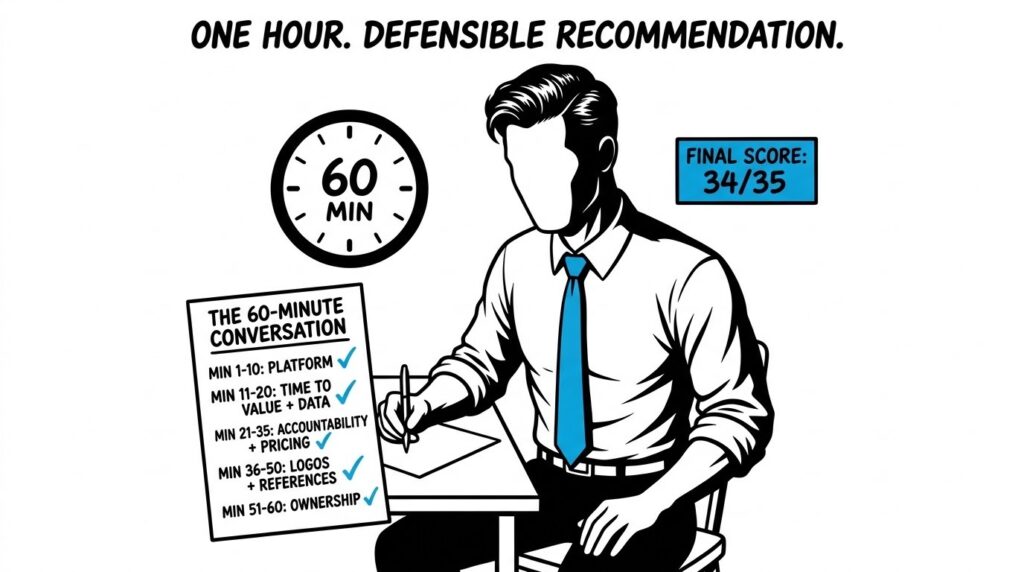
Minutes 1–10: Ask the vendor to describe their platform (Question 1). If they do not have one, note it. This shapes the rest of the call.
Minutes 11–20: Time-to-first-value and data methodology (Questions 2 and 3). Get specific numbers. “It depends” without a range is a disqualifier.
Minutes 21–35: Accountability and pricing (Questions 4 and 5). Get a name for your account owner. Get a number for the engagement cost. Any business intelligence consultant worth hiring answers both without flinching.
Minutes 36–50: Customer logos and references (Question 6). Request a reference call with a client in your industry or at your scale.
Minutes 51–60: Post-engagement ownership (Question 7). Close with: “If we sign, what do we own when this ends?”
Score each answer 1 to 5. Share the scorecard with your executive team. The framework removes subjectivity. It replaces “I liked them” with “they scored 34 out of 35.” That is a defensible recommendation. The vendors that win are the ones that consistently answer evidence questions with specifics. The vendors that lose ask to take questions offline.
The verdict and your next step
The right AI consulting firm answers all 7 questions clearly. With named evidence. With published pricing. With customer logos your procurement team can verify. With a platform underneath the consulting. With a time-to-first-value measured in weeks, not quarters.
FreshBI welcomes that evaluation. Over 300 clients have run it. The answers hold up.
If you want the 60-minute conversation above, book a call. If you want to see the numbers first, see pricing. Both pages load in seconds. Neither requires a form.
The framework is yours. Use it on every vendor, including FreshBI. The firm that scores highest earns your business.
Frequently Asked Questions
How should we set up an internal evaluation committee?
Assign clear roles across finance, IT, data, security, and the business unit that will own outcomes. Define who has decision rights versus advisory input. Align upfront on success criteria, constraints, and a single scorecard owner to prevent stakeholder drift.
What security and compliance questions go beyond a vendor’s marketing claims?
Request the security posture in writing: data handling, access controls, encryption standards, audit logging, incident response. Ask whether they can meet your specific regulatory requirements (SOC 2, ISO 27001, HIPAA, GDPR) and how they support vendor risk assessments.
How do we evaluate integration with our existing tech stack?
Have them map a target architecture against your current systems (ERP, CRM, data warehouse, BI tools, identity provider) and identify required connectors, data movement, and operational ownership. The best signal is a concrete integration plan with dependencies, environments, and cutover steps.
What should we require for change management and adoption?
A rollout plan with training, documentation, stakeholder communications, and a feedback loop tied to usage metrics. Adoption responsibilities must be explicit: who trains users, who supports them after launch, how improvements are prioritized.
How do we validate references without relying on curated success stories?
Ask for references that match your size, industry constraints, and deployment environment. Use a consistent reference checklist. Focus on delivery reliability, collaboration quality, and what broke in production, plus how quickly the vendor responded.
What contract terms should we pay close attention to?
Scope definitions, acceptance criteria, change order rules, confidentiality, IP ownership, limits on subcontracting. Confirm non-solicitation, termination clauses, and service level expectations for support so you do not inherit hidden risk after go-live.
What ongoing operating model should we plan for after launch?
Who owns data quality, model monitoring, access governance, and release management. How incidents are triaged and resolved. Regular business reviews with agreed metrics, a backlog process, and a clear budget line for maintenance and improvements.