AI and Machine Learning
Agentic AI for Business: What Executives Need to Know in 2026

Agentic AI is software that plans and executes multi-step business tasks on its own. Unlike a chatbot that waits for a prompt or an RPA bot that replays a recorded script, an agentic system reads live data from connected systems, decides what to do next based on a goal, uses tools (APIs, databases, documents) to act, and updates the state of the business when it finishes.
Every executive in your orbit has heard the term at least three times this quarter, and each person who said it meant something different. One meant chatbots. Another meant workflow automation with a new label. A third meant something closer to science fiction. The category is young, the hype is loud, and vendors have every incentive to blur the lines. This is the plain-English version: a definition that does not require a glossary, an honest comparison to what you already own, real use cases running in production, what still breaks, and a five-question framework for your next vendor call.
Table of Contents
- What agentic AI is
- How it differs from chatbots, RPA, and traditional AI
- What agentic AI can do today
- What agentic AI still cannot do reliably
- Three architectural patterns
- Where FreshBI fits: four production AI agents
- How to evaluate an agentic AI partner: five questions
- The verdict and the next step
What agentic AI is
Agentic AI is software that plans and executes multi-step business tasks on its own. Unlike a chatbot that waits for a prompt or an RPA (Robotic Process Automation) bot that replays a recorded script, an agentic system reads live data from connected systems, decides what to do next based on a goal, uses tools (APIs, databases, documents) to act, and updates the state of the business when it finishes.
The difference between a calculator and an analyst is a useful frame. The calculator answers the question you type. The analyst looks at the spreadsheet, finds what is wrong, pulls data from two other systems, drafts a recommendation, and flags the CFO. Agentic AI sits closer to the analyst end. It holds a goal, breaks it into sub-tasks, picks the right tool for each, and handles exceptions along the way.
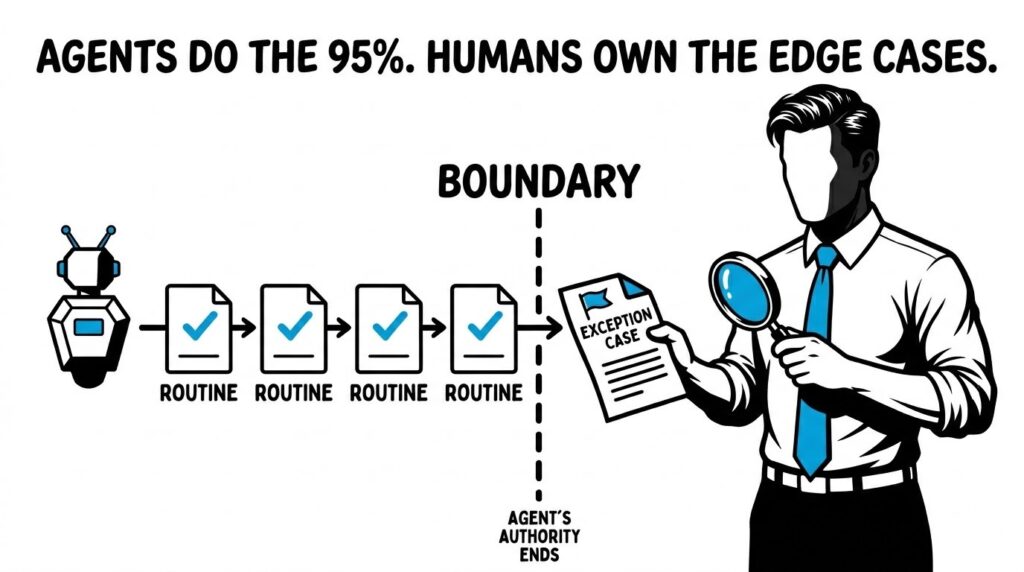
The word “autonomous” scares executives for good reason. Production deployments are not unsupervised. Every serious one includes guardrails: human-in-the-loop checkpoints, permission boundaries, audit trails. Autonomy here means the agent does not need a human to click “next” between every step. It handles a five-step process and only escalates when it hits a boundary it cannot cross.
How it differs from chatbots, RPA, and traditional AI
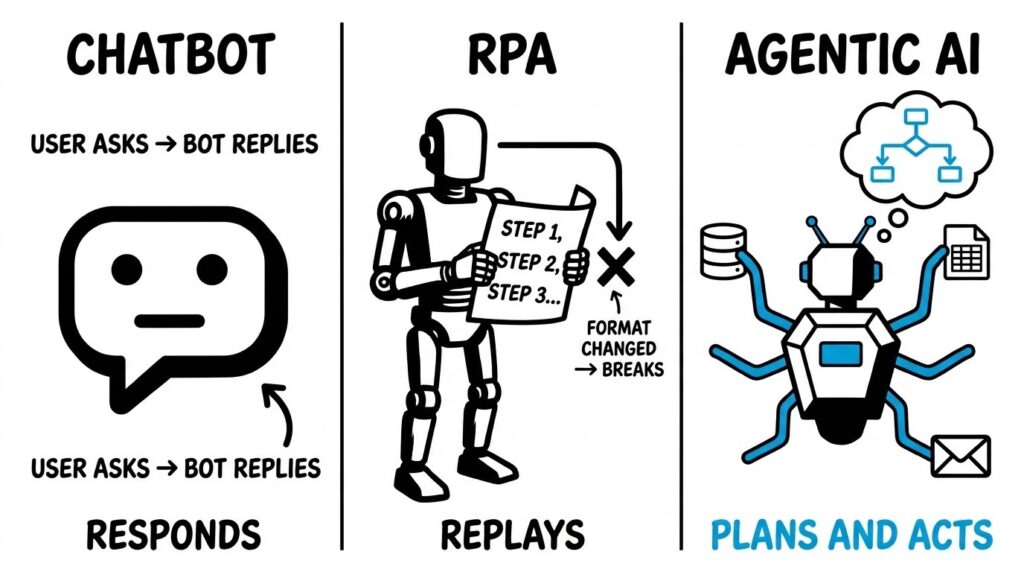
Chatbots respond. RPA replays. Agentic AI plans and acts.
A chatbot receives a prompt and returns a response. No memory of a goal across turns. No access to business systems beyond what you paste into the prompt. Useful, but bounded.
RPA records clicks and keystrokes, then replays them on a schedule. Brittle by design. Change a field label, move a button, or introduce a new exception and the bot breaks. RPA does not reason. It follows a fixed path. That works for high-volume, zero-variance tasks. It fails the moment the process requires judgment.
Agentic AI sits above both. It holds a goal, decomposes it into steps, picks the right tool for each, and adapts when conditions change. No pre-recorded script. The agent builds the script on the fly based on what it reads from your systems.
What agentic AI can do today
Agentic AI is running in production across finance, procurement, support, sales, and supply chain. Not lab experiments. Five concrete examples.
Finance close automation. An agent pulls trial balance from the ERP, reconciles intercompany transactions against sub-ledgers, flags mismatches above a threshold, drafts journal entries, and posts them after approval. Four days becomes one. AIG and Wells Fargo are investing in AI workflows that compress the close cycle and reduce reconciliation errors.
Vendor onboarding. The agent ingests a W-9 or W-8BEN, validates the tax ID against IRS records, checks OFAC and SAM.gov, populates the vendor master in the ERP, and routes the record for approval. Two weeks becomes hours.
Customer support triage. Most support bots answer questions. An agentic system reads the ticket, classifies severity, checks order status in the OMS, applies a credit or initiates a return in the CRM, and sends a resolution email. It only hands off to a human when the case exceeds its authority. Disney’s customer experience teams are among the enterprises connecting support interactions to back-end systems this way.
Sales pipeline hygiene. The agent scans Salesforce, finds deals with no activity in 14 days, cross-references email and calendar data for recent contact, updates the stage if the deal has gone cold, and notifies the rep with a next action. Pipeline data stays current without relying on reps to update fields.
Supply chain exception alerting. The agent monitors shipment milestones against contractual SLAs, compares carrier ETAs to customer delivery promises, flags at-risk shipments before they miss their window, and pre-books backup capacity when a threshold breaches. Gartner projects that by 2028, 33% of enterprise software applications will include agentic AI, up from less than 1% in 2024. Nestlé, FedEx, and Intel are investing here first.
What agentic AI still cannot do reliably
Agents break on novel inputs, unstructured exceptions, and tasks outside their tool boundaries. Acknowledging the limits is the difference between a successful deployment and a costly rollback.
Hallucination on novel scenarios. When an agent hits a scenario absent from its training data or retrieval context, it fills the gap with plausible-sounding fabrication. A confidently wrong journal entry in finance. A filed document with invented data in compliance. The failure mode is not silence. It is false confidence. Every production deployment needs a verification layer that catches these before they reach a downstream system.
Brittleness against unstructured exceptions. Agents handle structured exceptions well. “Amount exceeds $10,000, escalate to manager.” That works. But “this vendor sent a contract in a format we have never seen, with terms that contradict our standard agreement” still requires human judgment. The agent does not know what it does not know.
Tool boundary limits. An agent can only act within the systems and APIs it has access to. If the resolution requires a phone call, a negotiation, or a system the agent cannot reach, it stalls. The best deployments define those boundaries explicitly and build escalation paths before the agent goes live.
Three architectural patterns
Production agentic AI follows one of three patterns. Which one fits your organization is the first strategic decision.
Single-vendor closed agents. Microsoft Copilot for Finance and Salesforce Agentforce are the visible examples. Fast to deploy. Tightly integrated with the vendor’s data model. The trade-off is portability. Your agent logic, workflow definitions, and data stay inside the vendor’s walls. If you run on a single stack, this works. Most mid-market and enterprise companies do not.
Open agent frameworks. Engineering teams build custom agents with full control over orchestration, memory, and tool access. The upside is flexibility. The downside is that your team owns every line of code, every failure mode, every upgrade cycle. Fits organizations with deep AI engineering talent and tolerance for infrastructure ownership.
Managed agent services with a data foundation. Production-ready agents paired with a structured data layer that grounds every decision in verified business data. The agent reasons against a curated ontology that maps how the business actually works, not raw database tables or unstructured documents. FreshBI operates in this third pattern. It is what we recommend when you need auditability, speed, and cross-system reach without building an AI engineering team from scratch.
Where FreshBI fits: four production AI agents
FreshBI deploys four production AI agents, each built on Ontology 1st Design and Medallion Architecture. The ontology maps business entities, relationships, and rules. The Medallion Architecture moves data from raw to curated in auditable stages. Together, they give every agent a verified foundation to reason against.
- CFO Agent. Tax classification, compliance validation, financial reconciliation
- DOT Agent. Regulatory compliance for transportation and logistics, flagging violations before they become fines
- ELE Agent. Logistics coordination, from load matching to carrier communication
- Cash Intelligence Agent. Real-time cash flow tracking, shortfall forecasting, collection prioritization
Each connects to your existing systems through FreshBI’s AI and machine learning infrastructure. No rip-and-replace. No 12-month deployment.
The agents are only as good as the data foundation they reason against. For organizations that need every agent decision to trace back to a source document, FreshBI’s sister brand Truzer, the AI Integrator, builds the live business ontology that grounds agentic AI in operational reality.
How to evaluate an agentic AI partner: five questions
Hand this list to your CTO and procurement lead. Works for closed-vendor agents, open frameworks, and managed services.
1. What is the data foundation? The agent reasons against data. What data, how current, how verified? If the vendor cannot explain the data layer, the agent is reasoning against stale exports or unstructured dumps. For the deepest version of this answer, see the live business ontology approach from Truzer.
2. Can you show me the audit trail? Every agent action should produce an immutable log: what data was read, what decision was made, what system was updated, what rule authorized the action. If the vendor says “we log everything” but cannot produce a sample audit trail in the sales process, treat that as a red flag.
3. How does the agent handle exceptions? Ask for the list of defined exception types and the escalation path for each. A vendor that cannot enumerate exception categories has not deployed in production.
4. What governance controls exist for multi-user access? Who can modify agent behavior? Who approves changes to decision rules? Role-based access, change logs, and approval workflows are table stakes. If the vendor treats governance as a future roadmap item, walk away.
5. What is the escalation path when the agent fails? Agents fail. Does the system notify a human? Does it pause the workflow? Does it roll back the action? The escalation path tells you more about production readiness than any feature demo.
The verdict and the next step
Agentic AI is real. It is running in production at enterprise scale today. The category is young, the edges are rough, the failure modes are serious. None of that changes the fact that organizations deploying agents against verified data foundations are compressing cycle times that competitors still measure in weeks.
The honest move is not to buy everything. Pick one high-value workflow, validate the data foundation, deploy an agent with clear guardrails, measure the result, and decide what comes next based on evidence.
Book a call. Bring your messiest workflow. Bring your skepticism. We will show you what an agent can do against your data today and where the boundaries are.
Frequently Asked Questions
How should teams pick the first workflow to pilot with agentic AI?
Choose a process that is frequent, time-sensitive, and measurable, but not safety-critical on day one. Prioritize workflows with clear inputs and outputs, stable ownership, and an obvious baseline so you can quantify lift within a few weeks.
What KPIs measure agentic AI success beyond time savings?
Track downstream quality metrics: rework rate, exception rate, SLA adherence. Business impact metrics: cash acceleration, leakage reduction, customer retention. Pair outcome KPIs with operational telemetry like tool-call success rate and escalation frequency to spot reliability issues early.
What change management steps help teams adopt agentic AI?
Define new roles and handoffs. Who reviews agent outputs. Who owns exception queues. Who signs off on rule changes. Short, task-based training. A clear escalation playbook. A feedback loop that turns frontline issues into quick updates.
How do leaders reduce data privacy and security risk?
Least-privilege access. Segregated environments. Treat prompts, logs, and retrieved documents as sensitive data with retention controls. Require vendor transparency on data handling, model training policies, and subprocessor access before connecting production systems.
How does agentic AI impact existing roles, and how should leaders communicate it?
Early wins come from shifting people away from repetitive coordination and toward exception handling, analysis, and stakeholder communication. Set expectations that the goal is capacity creation and quality improvement. Publish clear boundaries for what the agent can and cannot do.
What integrations or prerequisites typically slow down a rollout?
Identity and access management. API readiness. Data standardization. Unclear system ownership. These create more delay than the AI itself. A quick integration assessment of required permissions and data sources prevents pilots from stalling.
When does it make sense to build in-house instead of buying?
Build when you have strong engineering capacity, unique workflows that are a competitive differentiator, and a need for deep customization. Buy when speed, compliance readiness, and ongoing maintenance would otherwise consume a large share of your team’s time.