AI and Machine Learning
Beyond the Data Warehouse: What a Semantic Layer Actually Is (and Why AI Agents Need One)

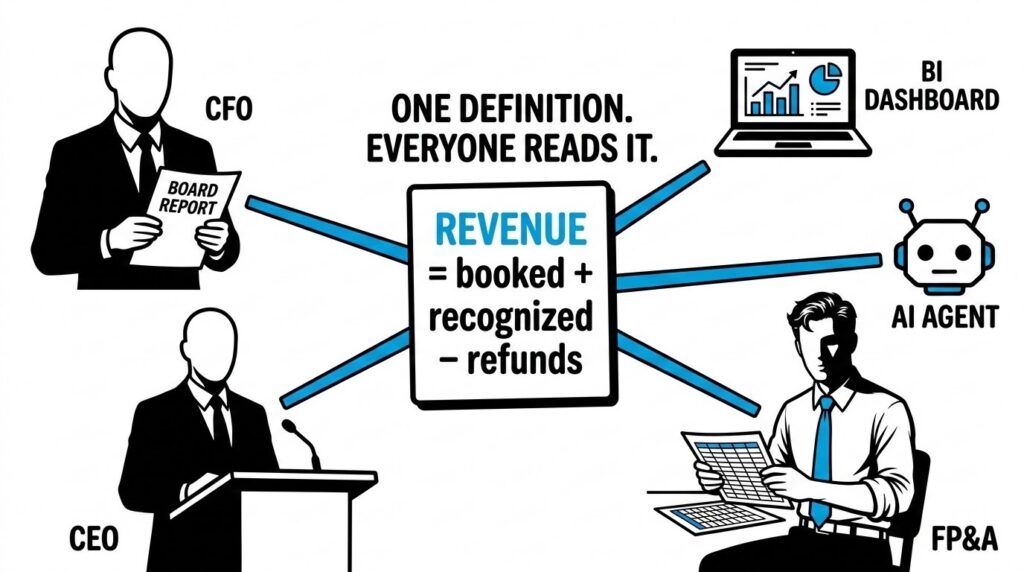
A semantic layer is the translation layer that turns raw database tables into agreed business terms, so every report, dashboard, and AI agent answers a question the same way your CFO would. It sits between your data warehouse and the tools your teams use, applying one governed definition of each metric to every query.
A semantic layer typically includes:
- Metrics — governed definitions of measures like revenue, churn rate, and average order value.
- Dimensions — the ways you slice those metrics: time, geography, product line, customer segment.
- Entities — the business objects themselves: customer, account, order, contract.
- Business rules — the logic that decides what counts (for example, when a customer is “active”).
- Metadata — the descriptions and relationships that tie the above together so humans and machines read them the same way.
The term semantic layer showed up in your last three data-team standups. Your VP of Data mentioned it on a Zoom call. Your BI lead dropped it into a Slack thread about “metric consistency.” You nodded. You moved on. The next board meeting is in six weeks, and someone will ask what your data strategy looks like above the warehouse. This is your eight-minute answer.
A semantic layer sits between your data warehouse and every tool or person that consumes data. It translates raw database columns into plain business language. A shared dictionary every report, dashboard, and AI agent reads from before answering a question. Without it, every consumer of your data has to guess what “revenue” means. And they guess differently.
The new word on every Zoom call
You already invested in a warehouse. You already hired analysts. You green-lit a BI tool (or three). If you read FreshBI’s guide on building an AI-ready data warehouse, you know what sits below this layer.
The warehouse is the foundation. The semantic layer is the floor plan that tells every occupant where the kitchen is, what counts as a bedroom, and which door leads outside. Without that floor plan, every visitor (analyst, dashboard, AI agent) wanders around opening random doors.
What a semantic layer actually is, in one paragraph
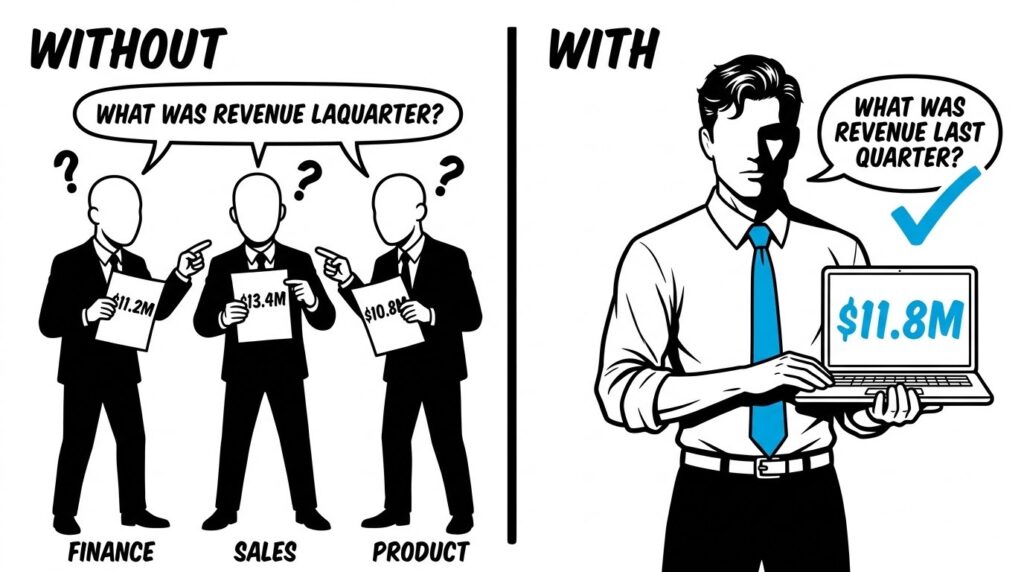
A semantic layer translates raw database tables into business concepts. “Customer” instead of `dim_customer.cust_id`. “Revenue” instead of `fact_orders.amt_usd_net_returns`. It defines these translations once, in one place, so every downstream consumer reads the same definition. Every BI tool, every Python notebook, every AI agent that queries your data gets the same answer to the same question. No more “my number says $4.2M and yours says $3.9M” conversations that burn an entire Monday.
Why the semantic layer matters now (and did not 10 years ago)
AI agents need business meaning, not just rows
Ten years ago, humans wrote SQL. Humans knew that `amt_usd_net_returns` meant net revenue. Today, AI agents write queries on behalf of executives who type plain English questions. Those agents have zero institutional memory. They need a formal map from business language to database columns. The semantic layer is that map. Without it, agentic AI guesses at column meanings and produces confident, wrong answers. That is the root cause of most AI hallucination in business analytics.
The multi-tool reality demands shared definitions
You run Power BI, Snowflake, dbt, and a dozen SaaS apps. Each tool has its own way of calculating “active customer” or “gross margin.” The semantic layer is the shared definition authority. It enforces one calculation for each metric, regardless of which tool requests it. As a DataCamp guide on semantic layers puts it, the layer democratizes data access by presenting business-friendly information that empowers more users to analyze data independently. Without it, self-service analytics breaks down.
The cost of conflicting numbers is now unbearable
Two analysts producing different revenue numbers from the same warehouse used to be an awkward meeting. Now it is a compliance risk, a board-level credibility problem, and a blocker for AI adoption. The semantic layer creates a single source of truth for metric definitions. Not a single database. Not a single dashboard. One governed definition of what each business concept means.
Where a semantic layer sits in your data stack
The modern data stack is a set of layers. Each layer handles one job. From the bottom up:
- Raw data sources: ERP, CRM, IoT sensors, SaaS APIs, flat files
- ELT / ingestion: tools that extract and load raw data into the warehouse
- Data warehouse: Snowflake, BigQuery, Databricks. FreshBI’s Medallion Architecture (Bronze, Silver, Gold, Platinum) governs data quality at this layer
- Semantic layer: translates physical tables into business concepts. Governs metric definitions, access rules, and caching
- Consumption: BI dashboards, Python notebooks, AI agents, embedded analytics. All read through the semantic layer
The warehouse handles storage and compute. The semantic layer handles meaning. Confusing them is the most common architectural mistake executives make.
How data fabric relates
You will hear data fabric in adjacent conversations. A data fabric connects data across distributed systems and automates data management. The semantic layer is one component inside it. It provides the business-meaning translation. The fabric provides the connectivity and automation wrapper. Complementary, not competing. FreshBI’s data platform architecture covers how these layers connect.
The 5 things a semantic layer must do to be production-ready
These five criteria separate a proof of concept from a production system. Use them when evaluating tools or vendors.
1. Define business concepts in one place. Every metric, dimension, and entity gets one canonical definition. “Revenue” is calculated one way. “Active customer” has one threshold. If two teams need different cuts, the semantic layer exposes both as named variants, not conflicting defaults.
2. Govern who sees what. Row-level and column-level security live in the semantic layer, not scattered across BI tools. Finance sees margin data. Sales sees pipeline data. The semantic layer enforces these rules before data reaches any downstream tool.
3. Cache expensive queries. Warehouse compute is expensive. A production semantic layer caches repeated queries so the same question does not trigger a full table scan every time an executive refreshes a dashboard. Good caching meaningfully reduces warehouse costs on read-heavy workloads.
4. Version changes safely. Metric definitions change. Tax rules update. Business units merge. The semantic layer versions every change so teams can trace when a definition shifted and why last quarter’s number looks different from this quarter’s.
5. Feed both human-facing BI and AI-agent-facing inference. A semantic layer that only serves dashboards is half-built. It must also expose a machine-readable API that AI agents query programmatically. The same metric definition answers a CFO’s dashboard question and an AI agent’s automated anomaly check.
Where FreshBI fits: Ontology 1st Design as the methodology
FreshBI builds semantic layers using Ontology 1st Design. The approach maps every business entity, relationship, and metric before writing a single line of transformation code. The Medallion Architecture (Bronze through Platinum) provides the data-quality foundation underneath. Ontology 1st Design provides the business-meaning layer on top.
Static definitions vs. a live business ontology
A semantic layer can be a static definition file you update by hand. Or it can be a live representation of the business that updates as transactions happen. FreshBI’s sister brand Truzer builds the live version. They call it a business ontology, or the live business ontology approach. If your business changes fast (logistics, supply chain, cold chain), the static version falls behind within hours.
What comes after the semantic layer
A traditional semantic layer defines meaning. A live business ontology embodies it. The difference matters.
A static semantic layer says: “Revenue equals sum of `amt_usd_net_returns` from `fact_orders` where `status = ‘completed’`.” That definition is correct until someone changes the schema, adds a new order type, or merges two business units. Then a human updates the file.
A live ontology stays current because it is connected directly to operational systems. It reflects the actual state of the business, not a snapshot from last Tuesday. Truzer (FreshBI’s sister brand) builds this as a unified digital twin. Entities, relationships, metrics, and policies update as transactions flow. AI agents grounded in the ontology do not hallucinate because they query live operational truth, not stale definitions.
For companies running complex, fast-moving operations, the ontology is the destination. The semantic layer is the on-ramp.
The verdict: should you build a semantic layer in 2026?
Yes, if you run more than one BI tool, employ more than one analyst, or have any plans to deploy AI agents against your data. The cost of skipping it is measured in wrong numbers on board slides, wasted analyst hours re-deriving the same metric, and AI agents that confidently produce fiction.
The first step is not buying a tool. It is auditing what already exists in your stack. You likely have partial semantic definitions scattered across dbt models, Power BI measures, and tribal knowledge in analysts’ heads. The work is consolidation and governance, not greenfield construction.
Book a call with FreshBI if you want the audit done right. The conversation starts with your stack, not a sales pitch.
Frequently Asked Questions
What is a practical first milestone when rolling out a semantic layer?
Standardize a small set of executive-critical metrics and ship them to one high-visibility dashboard. That creates an immediate trust win, then expand coverage to other domains and teams iteratively.
Who should own the semantic layer: data engineering, analytics, or business teams?
A joint model: data engineering owns reliability and performance, analytics owns metric logic, business stakeholders approve definitions. Assign a single accountable owner, but govern definitions through cross-functional review.
How do you handle metric disagreements across departments without blocking progress?
Treat disagreements as a governance decision, not a technical debate. Document the approved definition and its intended use case. When multiple valid interpretations exist, publish clearly named variants so teams stop arguing over an overloaded metric name.
What is the difference between a semantic layer and a metrics store?
A metrics store focuses on defining and serving metrics consistently, usually for BI and experimentation. A semantic layer goes broader by modeling entities and dimensions, applying access rules, and supporting multiple consumption patterns across tools.
How can you prove ROI for a semantic layer beyond reduced confusion?
Measure dashboard load performance, reduced duplicate metric definitions, fewer ad hoc reconciliation requests, and shorter time-to-answer. Tie those to hard costs: analyst time saved, rework avoided in reporting and experimentation.
What common mistakes cause semantic layer projects to fail?
Teams try to model everything at once, skip stakeholder sign-off, or ship definitions without clear naming conventions. Another frequent failure: treating it as a one-time build instead of an ongoing product with release management.
How should you train and onboard teams so adoption sticks?
A short enablement path: a metric catalog, example queries for common workflows, role-based training for analysts, executives, and engineers. Update templates and default dashboards to use the semantic layer so the new path is the easiest path.