
AI and Machine Learning
AI for Manufacturing: A Practical Roadmap for Operations Leaders

AI for manufacturing is the practical application of machine learning and AI agents to four core operations: predictive maintenance, quality inspection, supply chain optimization, and generative design. The use cases are proven. The deployment path is where most plants get stuck.
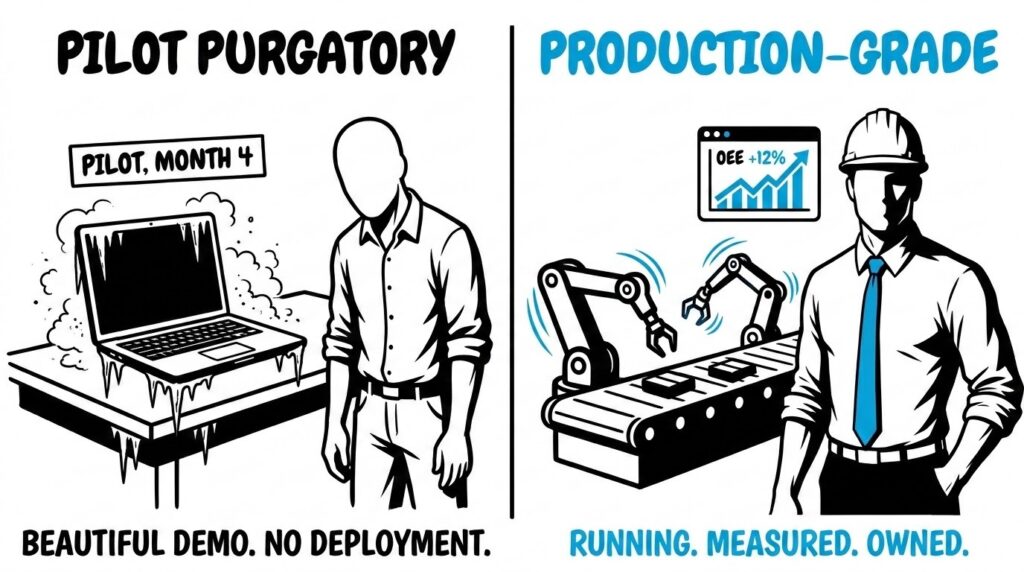
Most pilots never make it past the demo. The proof-of-concept runs for 90 days, the data science team presents results, and nothing changes on the shop floor. The model sits in a notebook. The line keeps running the way it always did. Operations leaders call it pilot purgatory. The problem is not the AI. It is the deployment path. This is a vendor-neutral roadmap to move from stuck pilots to production-grade AI across your plant in 2026 and beyond.
Table of Contents
- Manufacturing leaders are running out of patience
- What AI for manufacturing actually means
- Why most manufacturing AI projects fail
- The 5-use-case manufacturing AI roadmap
- Where FreshBI fits: Power BI and the Medallion Architecture
- What comes after manufacturing AI
- The verdict and your next step
Manufacturing leaders are running out of patience
The hype cycle for manufacturing AI started around 2018. Seven years later, the gap between “successful pilot” and “deployed at scale” is still enormous. A 2025 National Association of Manufacturers report found that 51% of manufacturers already use AI in their operations, yet 82% cite a lack of AI-ready skills as the top workforce challenge. The pilots work. The organizations are not ready to absorb them.
Your competitors are solving the readiness problem. BMW Group launched an “AI at Scale” roadmap with a vendor-agnostic data and MLOps layer. A 2025 study found that hundreds of AI applications now run in BMW’s series production, cutting rework and boosting logistics throughput across multiple plants.
The difference between BMW and the average manufacturer is not budget. It is sequencing. They built the data foundation first. They standardized deployment. They picked use cases that connected to existing workflows. This guide follows the same logic, adapted for operations leaders who do not have BMW’s headcount but need the same results.
What AI for manufacturing actually means
The phrase covers everything from a chatbot answering HR questions to a neural network predicting bearing failure. Operations leaders need a sharper map. Four domains are production-ready today. Everything else is experimental or niche.
Predictive maintenance. Vibration monitors, thermal cameras, and motor current signatures feed a model that predicts asset failure before it happens. The model outputs a maintenance window. The team acts during planned downtime instead of reacting to a line-down event. Start here if your unplanned downtime exceeds 5% of operating hours.
Quality inspection with computer vision. Cameras on the line feed images to a vision model trained on defect patterns. The model flags nonconforming parts in real time. Works best in high-volume, repeatable processes. PCB assembly, automotive stamping, and food packaging are strong fits.
Supply chain forecasting. Demand models ingest sales history, supplier lead times, and external signals like weather or port congestion. The output is a more accurate demand plan. Value is inventory reduction and fewer stockouts. Matters most to manufacturers with complex BOMs and long lead times.
Operational intelligence on the shop floor. The layer that connects MES, SCADA, and ERP data into one live view of plant performance. AI adds anomaly detection and root-cause analysis on top. Instead of a wall of dashboards nobody watches, you get alerts tied to OEE, throughput, and cycle time. This is the domain that ties the other three together.
Why most manufacturing AI projects fail
Three failure modes account for most stalled projects. Fix all three before you select a use case.
Plant-floor data is not ready
Sensor timestamps drift. PLC tag names vary across lines built in different decades. Historians store data at inconsistent sample rates. Nobody owns the pipeline. IT owns the network. Operations owns the process. Maintenance owns the sensors. Nobody owns what connects them.
The fix is not an 18-month data lake project. It is a scoped data foundation for your first use case. Identify the 10 to 15 data points the model needs. Trace them to source systems. Validate freshness, completeness, and ownership. Weeks, not quarters.
The pilot lives on the wrong vendor’s data island
Pilots run inside a single vendor’s sandbox. The data gets copied into the vendor’s cloud. The model trains on a snapshot. When the pilot ends, the model cannot reach live production data without a full integration project nobody budgeted for.
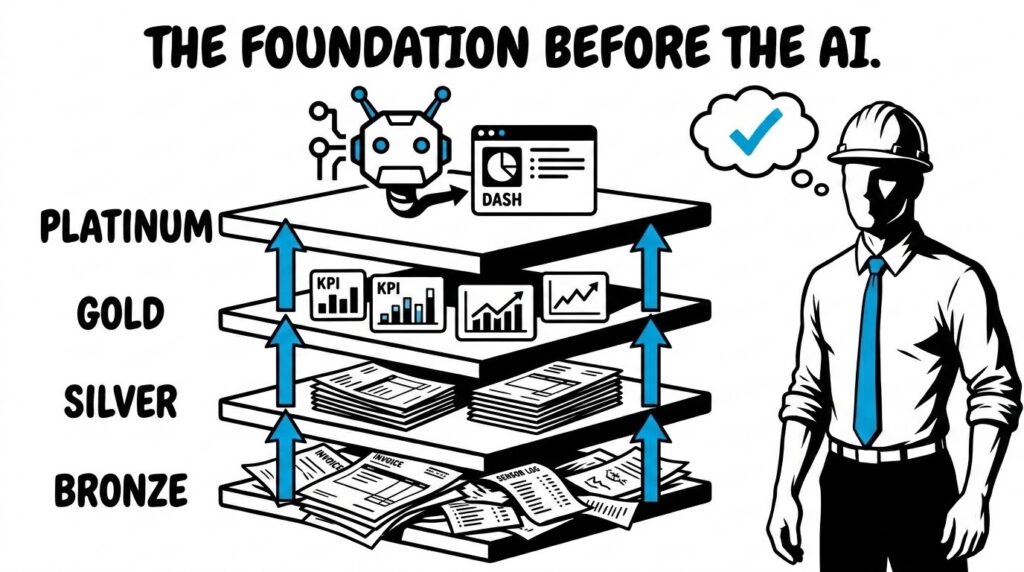
Build on open standards and your own data architecture from day one. The Medallion Architecture (bronze, silver, gold) gives you a vendor-neutral foundation. Pilot data lands in bronze, gets cleaned in silver, serves the model from gold. When you scale, the second use case uses the same pipeline.
The AI predicts but nothing changes on the floor
The model predicts a bearing will fail in 72 hours. The prediction lands in a dashboard. The maintenance planner never opens the dashboard. The bearing fails. The line goes down.
Operational integration means the prediction triggers a work order in your CMMS. It assigns a technician. It reserves the part. The model does not just inform. It acts. Without the last-mile integration, AI for manufacturing is expensive reporting.
The 5-use-case manufacturing AI roadmap
Sequenced by data readiness, implementation difficulty, and ROI speed. Each builds on the data foundation of the one before. Do not skip ahead.
1. OEE dashboarding with AI anomaly detection
Connect your MES and historian data into one OEE view. Add anomaly detection that flags deviations from normal availability, performance, and quality. Not a predictive model. A baseline. You learn which lines run well, which degrade at shift change, and where losses hide. Most manufacturers find 5 to 15 points of OEE improvement opportunity in the first 30 days. This also proves your data pipeline works before you invest in anything more complex.
2. Predictive maintenance on critical assets
Pick three highest-consequence assets — the machines where failure stops the entire line. Install vibration and temperature sensors if they are not in place. Train a failure prediction model on 6 to 12 months of maintenance history. Connect the output to your CMMS so predictions generate work orders automatically. Measure unplanned downtime reduction and MTBF improvement. Pays for itself within one avoided line-down event on most high-throughput lines.
3. Automated quality inspection
Deploy camera-based inspection on a single high-volume line. Train the vision model on labeled defect images from your existing quality records. Start in shadow mode where the model flags defects but a human makes the final call. Graduate to automated reject once accuracy exceeds your current manual rate. Reduces scrap and rework costs. Generates a quality dataset that feeds root-cause analysis downstream.
4. Demand forecasting with operational signals
Traditional forecasts use sales history. AI-augmented forecasting adds operational signals: current production capacity, supplier lead time variability, raw material availability, logistics constraints. The result accounts for what you can actually produce, not just what the market wants. Reduces inventory carrying costs. Improves on-time delivery. For manufacturers exploring AI and machine learning models beyond the shop floor, demand forecasting is the natural bridge. AI in logistics is the adjacent story.
5. Supply chain risk monitoring
Extends AI beyond your four walls. Risk models ingest port congestion data, supplier financial health signals, weather, and geopolitical indicators. They surface threats before they hit your production schedule. The model does not just monitor your plant. It monitors the network that feeds your plant. Autonomous AI agents watch these signals 24/7 and escalate only when action is needed.
Where FreshBI fits: Power BI and the Medallion Architecture
FreshBI builds manufacturing AI on a foundation most operations teams already own: Power BI, AI agents, and the Medallion data architecture. Manufacturers do not need another platform. They need existing infrastructure connected, cleaned, and made actionable.
Bronze ingests raw data from MES, SCADA, ERP, and historians. Silver cleans and conforms it. Gold serves production-ready datasets to Power BI reports and AI models. Every use case in the roadmap above runs on this same foundation.
Manufacturing AI is only as good as the operational data feeding it. For organizations that need real-time visibility across the entire production-to-delivery chain, FreshBI’s sister brand Truzer’s industrial AI Integrator approach connects the operational systems your plant floor, dispatch, and logistics teams already run.
What comes after manufacturing AI
Manufacturing AI solves problems inside your four walls. Your business does not end at the loading dock. Orders flow in from customers. Raw materials from suppliers. Finished goods out through logistics. Plant data is one piece of a much larger system.
The next step is connecting plant data to dispatch, logistics, and supply chain systems. Truzer (FreshBI’s sister brand) is the AI Integrator that connects systems of record across the full operational chain. Your MES, TMS, ERP, and IoT data feed one operational view.
This matters because the best manufacturing AI use case in the world fails if the logistics team cannot see the production schedule. And the supply chain team cannot act on a demand forecast if they do not know what the plant can actually produce this week. Truzer closes the gap without replacing anything you already run.
The verdict and your next step
If your manufacturing AI is stuck in pilot, the issue is almost never the AI. It is the data foundation and the operational integration path. Models work. Algorithms work. What breaks is the connection between a prediction and an action on the floor.
The roadmap is clear. Start with OEE visibility to prove your data pipeline. Scale into predictive maintenance. Add quality inspection and demand forecasting as the foundation matures. Extend into supply chain risk monitoring when you are ready to look beyond your four walls.
Before you evaluate vendors, get your baseline right. Sequencing matters more than vendor selection. Pick the wrong use case first and you waste six months. Pick the right one and you ship in 90 days.
Book a call and stop letting pilots sit in notebooks.
Frequently Asked Questions
How do I choose the first line or plant area to start with AI?
Start where you have stable operations, clear ownership, and reliable instrumentation, not necessarily where the problem is biggest. A controlled start proves the end-to-end workflow quickly, then you replicate it into more complex areas.
What roles should be on the core team?
Operations owner, controls or automation engineer, IT or data platform lead, maintenance leader (for reliability use cases), and a data practitioner who can productionize models. Assign a single accountable owner to prevent handoff gaps.
How should I think about cybersecurity and access control between OT and IT?
Network segmentation, least-privilege access, audited service accounts for data movement between OT and IT. Coordinate with security early so authentication, patching constraints, and vendor remote access are designed in, not bolted on later.
How do we handle data labeling for computer vision without overwhelming the quality team?
Start with a small, high-confidence labeling set. Expand using active learning where the model suggests the most informative samples next. Build a simple review workflow inside existing quality processes so labeling stays lightweight.
What KPIs prove ROI to finance beyond model accuracy?
Cost and throughput metrics: labor hours saved, scrap dollars avoided, expedited freight reduced, schedule adherence. Establish a pre-launch baseline and a simple benefits model so you attribute gains to operational changes, not analytics activity.
How do we manage change on the shop floor so teams trust AI recommendations?
Involve supervisors and technicians in defining what the system should flag, how it should escalate, and what a good action looks like. Short feedback loops. Clear override rules. Visible wins. The system is treated as a tool, not a black box.
When should a manufacturer build AI in-house versus partner?
Build in-house when you have repeatable use cases, stable data infrastructure, and dedicated capacity to maintain models. Partner when speed matters, your team is bandwidth-constrained, or you need proven patterns for production deployment and governance.