
AI and Machine Learning
Retail Demand Forecasting: The Forecast Starts With the First Conversation
The Forecast That Missed the Promotion You Told Us About
In the first conversation, a merchandising lead explains how their business actually works. There's a big promotion every November. Two hero products sell out within days of it starting. The overseas supplier takes six weeks to deliver, so anything not ordered by early September simply won't be on the shelf. Everyone on the call nods.
Three weeks after kickoff, the first demand forecast arrives. It's built on twenty-four months of sales history, it's cleanly charted, and it treats November as an ordinary month with a seasonal bump. Nothing about the promotion, the two hero products, or the six-week lead time made it into the model. The merchandiser reads it, sighs, and starts explaining everything again.
Why Forecasts Start From History Alone
It isn't carelessness. The people building a forecast are handed what's easy to hand over: a sales export. The facts that actually shape demand live somewhere else, in a conversation, a promotion calendar in someone's inbox, a supplier email thread.
- Sales history is not demand. When a product is out of stock, sales drop to zero, but demand didn't. A model trained on that history learns that the product is less popular than it really is.
- Promotions distort the past. A spike in history could be a trend or a one-off campaign. Without the promotion calendar, a model can't tell which, and will often repeat or ignore the spike for the wrong reason.
- Lead time sets the horizon. A forecast that looks four weeks ahead is useless for a product that takes six weeks to arrive. How far ahead to forecast is a business fact, not a statistical one.
- New products have no history at all. The only information about a launch is what the business said about it, and that was said in a meeting, not captured in a table.
What Changes When the Same Agent Builds the Forecast
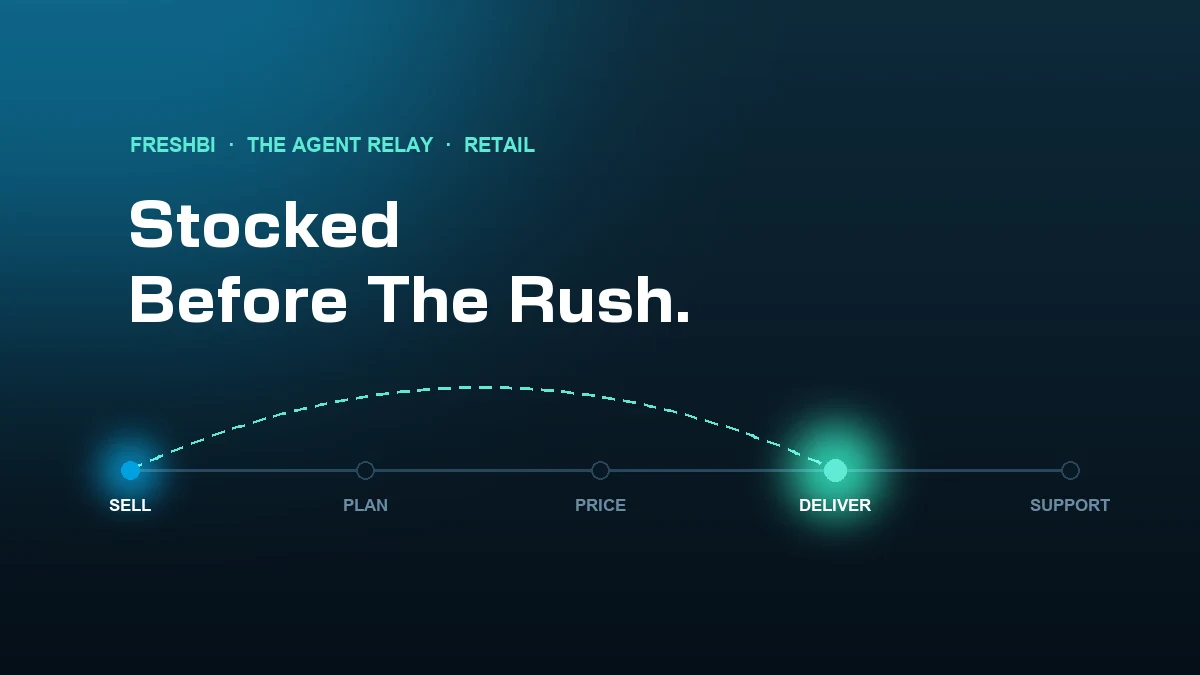
In an Agent Relay, the forecast isn't built from an export handed over after the fact. It's built by the same agent that was in the first conversation. The November promotion, the two hero products and the six-week lead time aren't notes in a brief. They're the inputs the forecast is designed around from day one, because they were stated directly, by the person who knows.
It's the same principle as the proposal and the delivery team, applied to a retailer's own operations: nothing is rediscovered later because nothing was lost in between.
What This Actually Looks Like
- The promotion calendar is an input, not an afterthought. Planned campaigns enter the model as events with dates, so a past spike can be explained instead of copied.
- The horizon matches the lead time. If a supplier needs six weeks, the forecast looks at least that far ahead, and flags the order deadline rather than the delivery date.
- Stockouts are treated as missing demand, not zero demand. Weeks when a product was unavailable are marked, so they don't teach the model that it's unpopular.
- New products borrow from what the business said. A launch with no history starts from comparable items the merchant named, then updates as real sales arrive.
Why This Matters Beyond Accuracy
A forecast that ignores something the merchant already said does more damage than a forecast that's merely a bit off. It teaches the business that the numbers can't be trusted with the things they know best, so they go back to spreadsheets and instinct, and the forecast becomes a report nobody acts on.
A forecast built from the same conversation reads differently. When the merchandiser sees the promotion and the lead time reflected, with the order deadline stated plainly, it stops being a model to argue with and becomes a plan to adjust. For a retailer, the cost of the alternative is concrete: stock that sells out in the week it matters most, or a warehouse full of what didn't.
Next In the Relay
This is the fifth post in the Agent Relay series, one continuous AI carrying context across the whole customer journey instead of resetting at every handoff. It's also the first aimed at a specific industry; see how we approach AI and BI for retail and e-commerce. Next up: manufacturing, and why a number like OEE shouldn't wait for the monthly report.
If your forecast was built without the promotion you mentioned in the first meeting, that's not a modeling problem. That's a relay with a broken leg.