

Right now, everyone in your group chat is suddenly talking about the lobster. Your tech-forward colleagues are obsessed with OpenClaw, the viral, open-source personal AI assistant created by Peter Steinberger that gained hundreds of thousands of GitHub stars almost overnight. They are telling you it is “the year of personal agents,” watching it clear inboxes, manage server configs over SSH, and automate workflows autonomously on their MacBooks. It is brilliant. It is autonomous. And if an employee installs it on a laptop with access to your corporate ERP, it is a security disaster waiting to happen.
The cultural moment around OpenClaw is creating real pressure on finance and operations leaders. Someone on your team is going to ask whether you can run OpenClaw instead of hiring an AI partner. The question deserves a real answer. A September 2025 Wakefield Research survey of 100 mid-market CFOs found that 86% of finance teams have hit AI hallucination issues in production. One CFO on Reddit summed up the current state of AI for finance as “a very smart but drunk assistant”. When the board asks what the AI is actually delivering, the answers are weak time-saved metrics and scenario projections one finance leader described as having “more holes than Swiss cheese”.
What follows is a direct comparison between two genuinely different products built for genuinely different buyers. One is a managed AI and BI consultancy for enterprise finance teams. The other is a self-hosted personal AI assistant for developers. The right answer depends entirely on whether your use case lives on a single laptop or across a regulated enterprise.
Table of Contents
Everyone in your group chat is suddenly talking about OpenClaw
OpenClaw hit a cultural nerve. Over 200,000 GitHub stars in a few short months. Viral demos on X showing an AI agent that controls your browser, reads your files, manages your calendar, and executes shell commands. The tagline is blunt: “The AI that actually does things.” Developers love it because it delivers on that promise on their own machines, under their own control.
If you run finance or operations at a mid-market or enterprise company, the cultural moment creates a specific pressure. Someone is going to ask whether your team can run OpenClaw instead of hiring an AI partner. That someone might be your CTO. It might be a board member who saw the demo at a dinner. It might be you.
Here is what you need to know before you answer. OpenClaw is a personal AI assistant built for developers and power users. FreshBI is a managed AI and BI partner built for finance and operations leaders. They share exactly one trait: both use large language models. Beyond that, they solve different problems for different people with different risk profiles. The right choice depends on whether your use case lives on a single laptop or across a regulated enterprise.
What FreshBI is
FreshBI is the AI and BI partner for finance and operations leaders who need governed data, ai powered bi, and a single accountable vendor. The engagement model is consultancy, not software license. FreshBI builds and manages a governed data platform around your systems, deploys AI agents that do real analytical work, and keeps the whole thing running under contract.
- Four AI Agents: CFO Agent (tax), DOT Agent (compliance), ELE Agent (logistics), Cash Intelligence Agent
- Architecture: Ontology 1st Design and the Medallion Architecture (Bronze, Silver, Gold, Platinum)
- Time to value: Three-week sprint to v0.9
- Pricing: $7,000/month or $77,000/year
- Customer base: 1,000+ companies including Disney, Nestlé, AIG, Intel, FedEx, and Wells Fargo
- Stack alignment: Microsoft-native
The operating model matters as much as the feature set. FreshBI owns the deployment, the maintenance, and the SLA. When something breaks at month-close, there is a named team on the other end of the phone.
What OpenClaw is, in OpenClaw’s own words
OpenClaw’s homepage headline reads: “OpenClaw — Personal AI Assistant. The AI that actually does things.” The documentation states the intended audience is “Developers and power users.” That positioning is not incidental. It is the product’s design center.
OpenClaw is an open-source, MIT-licensed, self hosted ai agent created by Peter Steinberger. You install it locally via `npm install -g openclaw@latest`. It runs on your machine. It connects to WhatsApp, Telegram, Slack, Discord, Signal, and iMessage. It has full system access, browser control, persistent memory, and shell execution. A skills marketplace at clawhub.ai extends its capabilities. It supports Claude, GPT, and local models.
The numbers speak for themselves: over 200,000 GitHub stars in a few short months, a thriving fork ecosystem, thousands of commits, and a steady stream of active issues and pull requests. This is not a toy project. OpenClaw is one of the most successful open-source AI projects in recent memory, and the developer community that surrounds it is passionate for good reason.
For an individual developer who wants an autonomous agent on their own laptop, one that handles inbox triage, browser automation, and terminal commands without sending data to a third-party cloud, OpenClaw delivers something genuinely new. The honesty of its positioning is part of its strength. It says “personal AI assistant” and it means it.
FreshBI vs OpenClaw: side-by-side at a glance
The table below compares these two products across the dimensions that matter most to an enterprise buyer evaluating them. Read it as a filter: if your requirements cluster on the left column, you need a partner. If they cluster on the right, you want a tool.
| Dimension | FreshBI | OpenClaw |
|---|---|---|
| Deployment model | Managed by FreshBI on client infrastructure | Self-hosted, installed via npm on personal device |
| License | Commercial SaaS / consultancy contract | MIT open-source license |
| Intended audience | Finance and operations leaders at mid-market and enterprise companies | “Developers and power users” (per docs.openclaw.ai) |
| Support tier | Dedicated account team, SLA-backed | Community (GitHub Issues, Discord) |
| SLA | Contractual uptime and response-time SLA | None |
| Compliance certifications | SOC2/HIPAA/GDPR-adjacent, governed data platform | Security program at “Phase 1 of 4” per trust.openclaw.ai |
| Multi-user / role-based access | Yes, built for teams | Single-user personal agent |
| Audit logging | Shipped, governed, immutable | Roadmap goal, not yet shipped (per trust.openclaw.ai) |
| Time to first value | Three-week sprint to v0.9 | Depends on developer skill and configuration time |
| Total cost over 36 months | $231,000 (annual plan) to $252,000 (monthly plan) | $0 license + LLM token spend + engineering time (see TCO section) |
The AI CFO question: personal AI assistant or enterprise AI partner?
This is where the comparison gets concrete for the buyer reading this article. You are a CFO, a VP of Finance, or a controller. You want an ai cfo capability: an AI agent that can handle tax calculations, surface cash flow anomalies, prepare variance analysis, and flag risks before the board sees them. Can OpenClaw do that?
Technically, pieces of it. OpenClaw has browser control, file access, shell execution, and persistent memory. A sufficiently skilled developer could configure it to pull data from your ERP, run calculations, and output a summary. The raw capabilities exist.
The deeper problem is architectural. As one CFO put it on Reddit: “Finance, audit, tax, and core business functions need deterministic, auditable execution, not ‘maybe-it-works’ models.” Large language models are probabilistic by design. They produce the most likely answer, not the verified one. For close-day reporting, tax calculations, and audit-ready financial output, “most likely” is not a category of acceptable answer. Another CFO documented the operational reality: “I would never take straight AI output and present it as a final deliverable. It’s good to bounce off of but every attempt I’ve made nets a result with more holes than Swiss cheese.”
But the product’s own positioning tells you who it is built for. “Personal AI Assistant. Developers and power users.” That is not a knock. That is a design decision, and an honest one. OpenClaw is built for a single operator on a single machine doing personal productivity work. It is not built for a five-person FP&A team that needs role-based access, audit trails, and a governed data layer beneath the agent.
Why the AI agent for finance needs accountability
FreshBI’s CFO AI Agent is an ai agent for finance built on a governed data platform, owned by the client, and accountable to the client under contract. When the agent produces a tax calculation, the data lineage is traceable from source system through the Medallion Architecture to the final output. When the number is wrong, there is a team you can call and an SLA that governs the response.
OpenClaw has no equivalent accountability structure. Not because the software is bad, but because the product was never designed to carry that weight. The question that decides the choice is simple: when the agent is wrong on close day, who at your company is accountable?

Where FreshBI fits: the enterprise OpenClaw alternative
FreshBI is built for regulated industries, multi-user finance teams, the tools you already run, and organizations that need SOC2/HIPAA/GDPR-adjacent compliance with time-to-value measured in weeks. The engagement comes with a single accountable partner. Disney, AIG, and Intel do not use FreshBI because they lack internal engineering talent. They use it because governed AI and BI for enterprise finance requires a different operating model than a personal productivity tool.
The honest case for OpenClaw
OpenClaw is one of the most successful open-source AI projects of the last two years. Over 200,000 GitHub stars, an MIT license, a thriving skills marketplace, and genuine delight from the developers using it. For an individual technical operator who wants an autonomous agent on their own laptop that handles inbox, calendar, browser, and shell, it is a credible choice. If you are a developer with the time and inclination to own the configuration and the security review yourself, you should probably try it.
Most enterprise finance and operations leaders are not in that position.
They manage teams. They report to audit committees. They operate under compliance frameworks that require traceable data lineage and role-based access controls. They need the AI agent to be correct on the first Monday of the month, every month, with a contractual guarantee behind that correctness. The gap between OpenClaw and FreshBI is not quality of engineering. It is the operating model around the engineering.
FreshBI vs OpenClaw: decision matrix by buyer profile
| Decision factor | FreshBI is the better fit when | OpenClaw is the better fit when |
|---|---|---|
| Time to value | You need a working system in three weeks | You have months to configure and iterate |
| Compliance | SOC2/HIPAA/GDPR-adjacent requirements exist | No regulatory compliance requirements |
| Multi-user access | Five-person FP&A team needs role-based access | Single user on a single device |
| Vendor risk | You need a contractual SLA and named support team | You accept community-only support |
| Microsoft-stack fit | Your org runs on Microsoft infrastructure | Stack alignment is not a factor |
| Production security review | InfoSec requires completed third-party audits | You own the security review yourself |
| Budget model | Predictable $7K/month managed cost | $0 license + variable engineering and token costs |
A note on the broader landscape: if your organization is already evaluating Microsoft Copilot for finance as part of a broader Microsoft investment, FreshBI complements that strategy because it works alongside your existing Microsoft investment while staying vendor-agnostic. OpenClaw operates independently of the Microsoft ecosystem.
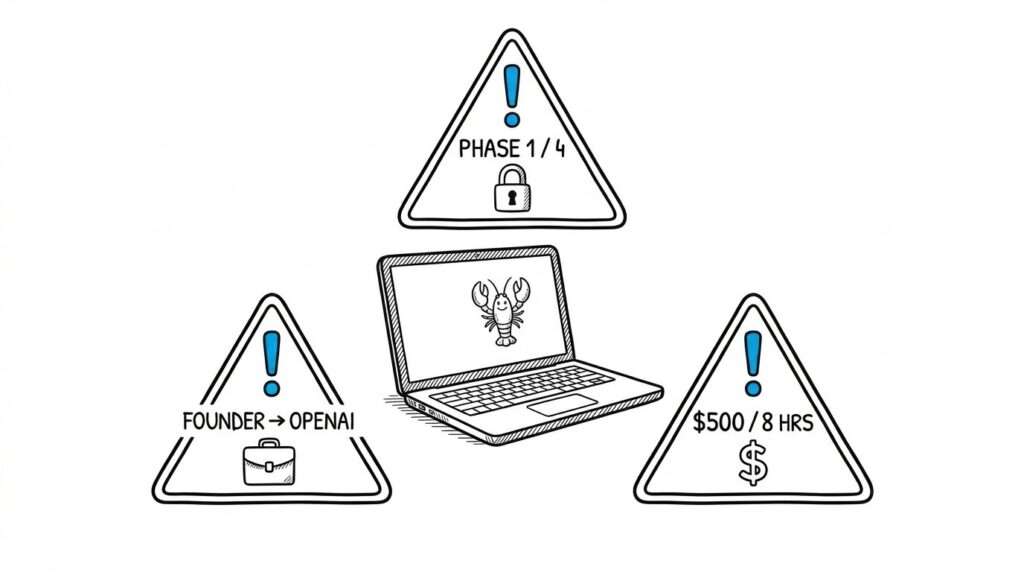
Three things to know before you run OpenClaw on a corporate laptop
Security maturity is early-stage
OpenClaw’s own security posture framing is explicit. On trust.openclaw.ai, the project describes its security program as “Phase 1 of 4.” That matters for corporate use because OpenClaw is designed to be agentic. It reads local files, controls a browser, and can execute shell commands. In an enterprise context, that combination is not “just another dev tool.” It is a privileged automation layer that can touch ERP exports, stored credentials, browser sessions, and internal web apps.
You also have to price in the real-world failure modes of autonomous agents. The OpenClaw community has already documented a prompt-injection compromise of the agent. One Information Security practitioner summarized the core risk in plain language: “summary requests are basically an injection surface.” If the agent is asked to summarize what it sees, a malicious page, document, or email can hide instructions inside that content. The agent can follow those instructions because it cannot reliably distinguish “data to summarize” from “commands to execute.”
Finance leaders should translate this into a governance question: if OpenClaw is on a corporate laptop, what is the blast radius when an agent is tricked into exfiltrating sensitive data or executing unsafe actions? If you cannot bound that blast radius tightly, you should not approve the deployment.
Founder transition changes the sustainability story
OpenClaw’s momentum is real, but the sustainability story is changing. According to openclaw.ai’s press section, Peter Steinberger joined OpenAI in February 2026. That does not mean the project is doomed. It does mean your enterprise risk profile changes if you were implicitly counting on one founder to drive roadmap execution, security hardening, and long-term maintenance. Open-source is resilient when there is deep bench strength and mature governance. If your finance stack depends on the project, you need to validate that resilience, not assume it.
Hidden TCO adds up fast
OpenClaw’s license cost is $0. That is not the same thing as “cheap.” The real cost center is engineering time plus ongoing operational overhead. Do the math with market rates. One strong engineer at $150 to $200/hour, even at a conservative 10 hours/week to build, harden, and maintain an internal OpenClaw-based workflow, is $6,000 to $8,000/month in labor alone. That is before LLM tokens, cloud workloads, monitoring, and security review time from InfoSec.
Cost overruns can be abrupt when agent workflows touch cloud infrastructure. One OpenClaw user on r/openclaw reported burning through “$500 in 8 hours of AWS credits” on a single weekend project. Even if your numbers are lower, the pattern is the same. Agentic systems consume tokens, spin compute, and generate logs and retries. That creates a variable cost model that is hard to forecast and harder to govern during quarter-end peaks.
A 2026 Federal Reserve study found approximately 30% of U.S. financial-sector firms had adopted AI, and 63% of workers in finance were already using generative AI on the job. The adoption question is settled. The implementation model question is not. That is what this comparison is really about.
The verdict and the next step
If you are an individual technical operator, OpenClaw can be a smart choice. It is powerful, flexible, and improving fast. If you are comfortable owning configuration, model selection, security controls, and ongoing maintenance, you can get meaningful personal productivity gains. For a developer automating their own workflow on their own machine, OpenClaw is legitimately compelling.
If you are running enterprise finance with audit committees, compliance requirements, multi-role access needs, and a CFO who needs the AI agent to be correct on the first Monday of every month, you need a partner.
Also evaluating other AI agent options? See our FreshBI vs Hermes Agent comparison.
Frequently Asked Questions
What should we define internally before evaluating any AI agent for finance?
Define the job to be done in operational terms: which workflows the agent will own, what “correct” means, and where humans must approve outputs. Document required inputs, required outputs, acceptable error rates, and the escalation path when the agent fails. Also define your control requirements up front: role-based access, audit logging, data retention, and who is accountable for month-close accuracy.
How can a finance team run a safe pilot without exposing sensitive data?
Start with non-sensitive, representative data. Use masked or synthetic datasets and restrict the pilot to read-only access. Keep the pilot in a segregated environment with limited network access, short-lived credentials, and explicit logging. Require a written “no external sharing” policy for prompts, files, and outputs, and confirm where prompts and logs are stored before anyone runs the agent on real financials.
What questions should InfoSec ask when an AI agent can execute shell commands or control a browser?
InfoSec should treat the agent like a privileged endpoint automation tool. Ask: what permissions does it have, how are secrets stored, how are actions logged, and how do you prevent data exfiltration? Require controls for prompt injection, allowlists for domains and commands, and sandboxing for browser automation. Most importantly: define the blast radius. If the agent is compromised, what systems and data can it reach, and how quickly can you revoke access?
How do we compare vendor and DIY options beyond features and pricing?
Compare accountability and operability. Who owns uptime, incident response, model changes, and regression testing? What is the path to audit-ready logs and traceable data lineage? Evaluate the ongoing maintenance burden: configuration drift, prompt updates, security patches, and month-close support. Features are easy to demo. Reliability under close pressure is the real differentiator.
What data governance capabilities should we require even for an early-stage rollout?
Require least-privilege access, defined data scopes, and immutable audit logs of what data the agent accessed and what actions it took. Enforce clear separation between raw data and curated reporting layers, with lineage that traces outputs back to source systems. Set retention and deletion policies for prompts and logs. If you cannot answer “where did this number come from,” you do not have governance.
What KPIs should we use to measure success for an AI agent in FP&A or controllership?
Use KPIs tied to finance outcomes, not novelty. Track cycle time reduction for close and forecasting, reduction in manual reconciliations, and variance analysis turnaround time. Measure accuracy using defined acceptance tests, plus rework rates and exception rates. For controllership, track audit readiness indicators: completeness of audit trails, time to produce support, and the number of controls that can be evidenced directly from system logs.