

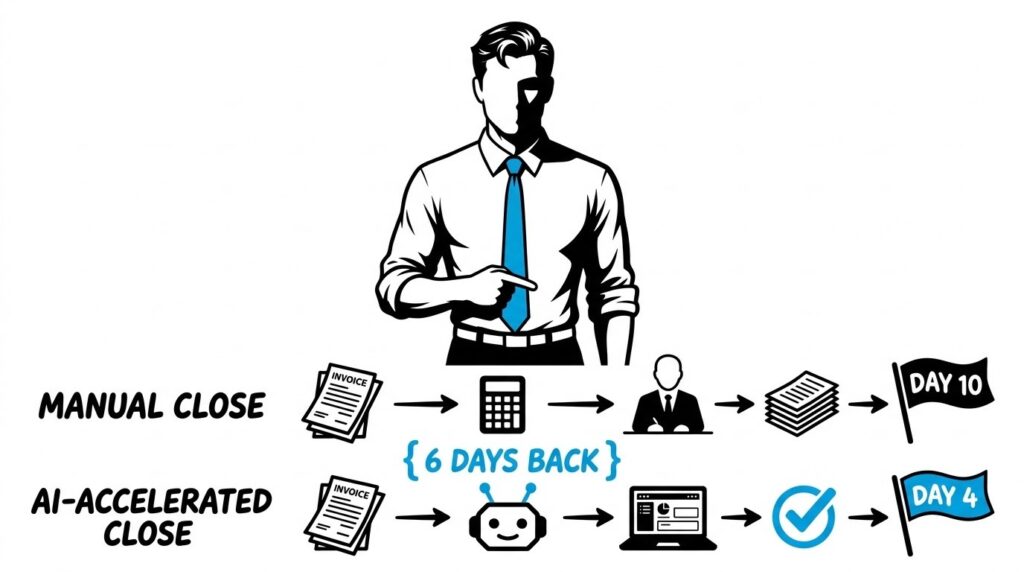
AI for FP&A is a set of finance-specific applications of AI that automate the highest-cost work in the close, forecast, and variance cycles. Pulling trial balance and flagging reconciliation breaks. Drafting variance commentary from posted entries. Generating rolling forecasts against live transactional data. The teams that have deployed it are closing books 30 to 40 percent faster and freeing FP&A analysts from the data-cleaning grind. The teams that have not are losing the productivity gap month over month.
If your last close ran 10 days, your last forecast missed by more than 5%, or your last variance walk landed after the board had already moved on, you already know why AI is on the agenda. This guide names the workflows that pay back first, the ones to keep human, and the traps that burn real budget. Built for the FP&A lead, finance director, or controller who has heard the pitch before, sat through the big-consulting deck that promised AI nirvana in 24 months, and watched a generic chatbot hallucinate a revenue number.
Table of Contents
The FP&A team has changed more in 18 months than in the previous 18 years
Month-end close used to take 15 days. Boards now expect five. Rolling forecasts used to update quarterly. Now they update weekly. Variance analysis used to land in a PDF three days after period close. Now the CFO wants the walk before the variance finishes forming.
The decision in front of you is not whether to adopt AI. It is which workflows to hand over first, which ones to keep manual, and how to dodge the two failure modes that have burned every early adopter: the generic AI tool that invents numbers and the enterprise project that ships in two years.
What “AI for FP&A” actually means
Strip the marketing language. AI for FP&A is not a chatbot bolted onto your ERP, a consultant feeding prompts into ChatGPT, or a dashboard with a “predict” button.
It is purpose-built models trained on structured financial data that run specific FP&A workflows with auditability built in. Generic AI tools fail against financial data because they lack the constraints finance requires: traceability to source transactions, tolerance controls on variance, and outputs an auditor will accept.
Four workflows where AI is production-ready
Forecast generation. AI ingests historical actuals, applies driver-based assumptions, and produces baseline forecasts your analysts refine. Most teams start here.
Variance analysis. AI compares actuals to forecast at the line-item level, attributes root causes, and drafts narrative explanations. The analyst still edits, but the 80% of manual comparison work disappears.
Scenario planning. Instead of building three scenarios by hand, AI runs dozens across your assumption ranges and surfaces the ones with the largest P&L impact.
Close automation. AI handles reconciliation matching, accrual suggestions, and consolidation checks. Highest risk to automate. Highest reward when it works.
The difference between AI for FP&A and generic AI for finance is specificity. FP&A-grade AI runs against your chart of accounts, your cost centers, your driver assumptions. For the executive layer that sits on top of these workflows.
Why FP&A teams adopt AI faster than CFOs
CFOs evaluate AI as a strategic investment. FP&A teams evaluate it as pain relief. The analyst who spends 60% of every week on data gathering does not need a business case. They need fewer tabs open.
FP&A teams own the forecast, the variance walk, and the board deck. When the number is wrong, they take the blame. That accountability creates urgency that a top-down CFO mandate rarely matches.
What the time savings actually look like
EY’s 2025 analysis found that up to 45 percent of FP&A time is still consumed by cleaning and reconciling data, and AI adoption surged from 6 percent in 2024 to 41 percent in 2025. The data-assembly labor is what AI removes first.
The analyst who used to spend four hours building a variance bridge now spends 45 minutes reviewing one the AI assembled. That is the role transformation from data assembler to decision advisor.
The 5-step AI for FP&A adoption framework
Every failed AI-for-finance project shares the same origin story: the team tried to automate everything at once. Sequence by risk and ROI. Each step builds trust before the next layer goes live.
Step 1: Map the workflows before you automate anything
Spend one full close cycle documenting every manual step. Who touches the data. Where it moves between systems. Where errors enter. Most teams discover 30% of close labor is data movement, not analysis. That 30% is the first automation target. Map it in a shared document with timestamps and owner names. It becomes your baseline for measuring AI impact later.
Step 2: Start with forecast generation
Highest ROI, lowest risk. AI generates a baseline forecast. Your analysts review it against their judgment. If the AI is wrong, you catch it before anyone else sees it. Run AI forecasts in parallel with your existing process for two cycles. Compare accuracy. Identify where the AI outperforms manual models and where it needs tuning. The parallel period builds analyst trust and surfaces data quality issues before they become production problems.
Step 3: Add variance analysis once forecasts are stable
AI compares actuals against the forecast it helped produce and attributes differences to specific drivers. The governance control: every variance attribution must trace back to a source transaction. If the AI says “revenue missed by $200K due to delayed contract starts,” an analyst must click through to the actual contracts. This traceability is where generic AI tools fail. Grounded outputs drop hallucinated variance explanations to near zero, which is the single most important technical requirement when evaluating any tool.
Step 4: Layer scenario planning
Where AI stops saving time and starts creating strategic value. Instead of building three scenarios by hand, AI generates a distribution across your key assumptions. The FP&A lead picks the scenarios worth showing the board. Human judgment is what to present. AI does the computational lift. This is the step where FP&A shifts from reactive reporting to proactive advisory.
Step 5: Automate close last
A bad forecast is embarrassing. A bad close is an audit finding. Start with low-risk close tasks: intercompany reconciliation matching, accrual suggestions. Keep journal entry approval human. Keep consolidation sign-off human. The goal is not full automation. The goal is a close where AI handles the 70% of matching and checking that eats analyst hours, while humans approve every posted entry.
Where FreshBI fits: the Cash Intelligence AI Agent
FreshBI’s Cash Intelligence AI Agent is this framework in production. Not a prototype. It runs against live transactional data for finance teams at Intel, FedEx, and Nestlé.
What the agent does
Three core workflows:
- Cash flow forecasting grounded in transactional source data, not statistical projections from aggregated GL balances
- Variance attribution that traces every discrepancy back to the underlying invoice or PO
- Scenario modeling across business-unit assumptions with audit trails on every input
The data foundation matters as much as the AI. FreshBI’s Ontology 1st Design and Medallion Architecture anchors every output in structured, validated source data. The AI does not guess. It reads from a governed layer that reflects the actual state of your business.
FreshBI’s AI Agents run continuously. They do not wait for an analyst to pull a report. They surface anomalies, flag forecast drift, and generate variance narratives as the data moves.
Some FP&A teams need every forecast to trace back to a source document with full audit auditability. For those teams, FreshBI’s sister brand Truzer adds a live business ontology that grounds every AI-generated number in the source that produced it. See ontology-based financial statement reporting for the traceability detail.
What comes after FP&A automation
Once your forecasting, variance, and scenario workflows run on AI, the natural next question is where else in the business the same grounded-AI approach creates decision value. Supply chain planning. Revenue operations. Workforce planning. They share the same underlying requirement: outputs that trace back to real data, not hallucinated projections.
Truzer (FreshBI’s sister brand) is built for that expansion. Where the Cash Intelligence Agent owns FP&A, Truzer provides a single control tower across the full operational stack. The ontology that powers financial traceability extends to logistics, procurement, compliance, and cross-functional planning. For FP&A leaders who proved the model inside finance and want to extend the rigor to operations, Truzer is the next deployment.

What AI should not replace
Knowing where to keep humans in the loop is as important as knowing what to automate.
Board communication. AI generates variance commentary. A skilled FP&A director turns that commentary into a story the board acts on. What to emphasize, what to flag as strategic risk, what to downplay. AI cannot do that.
Assumption setting. AI runs scenarios across assumptions, but the assumptions reflect business strategy. The decision to model a 5% price increase versus 10% is strategic, not computational.
Stakeholder relationships. The FP&A business partner negotiating a realistic budget number with a department head is doing relationship work no agent can replace.
The honest split: AI handles computation, pattern recognition, and data assembly. Humans handle judgment, communication, and strategy. Teams that automate judgment tasks get burned. Teams that refuse to automate computation tasks fall behind.
How to evaluate AI for FP&A tools
Every ERP vendor now claims AI capabilities. Every BI tool added a “predict” button. Here is what to actually evaluate.
Traceability. Ask the vendor to show you the source transaction behind any AI-generated number. If they cannot trace a forecast figure back to the invoice or journal entry that informed it, the tool lacks the governance FP&A requires.
Hallucination controls. Ask how the model handles data gaps. A production-grade FP&A tool returns “insufficient data” rather than fabricating a plausible number. For the deeper treatment, our buyer evaluation framework covers hallucination risk and model governance.
ERP integration depth. Surface-level API connections are not enough. The tool must read your chart of accounts, your cost center hierarchy, and your driver assumptions natively. Demo it against your actual GL, not a sample dataset.
Tightly scoped pilots, measurable KPIs from day one, and a documented escalation path are what separate teams that scale from teams that stall in evaluation theater.
The verdict and your next step
The framework is straightforward. Map your workflows. Start with forecast generation. Add variance and scenario planning. Automate close last. Keep judgment, communication, and assumption-setting human. Measure everything from day one.
The next step is a 60-minute conversation about your current FP&A workflows. We will map the specific processes where AI creates immediate ROI and identify the ones that should stay manual.
Book a call and bring your close calendar. We will show you where the hours go and which ones AI gives back.
Frequently Asked Questions
How should FP&A teams handle data privacy and access controls when deploying AI?
Start with role-based access that mirrors finance responsibilities, then enforce least-privilege permissions down to entity, cost center, and document level. Encrypt in transit and at rest. Log every data access and model output viewed or exported.
Which internal stakeholders should be involved early?
FP&A, controllership, IT data engineering, information security, and internal audit, so controls and deployment constraints get aligned upfront. Include one or two business leaders (sales or operations) to validate driver definitions and reporting expectations.
What does a realistic change management plan look like?
Treat adoption as a workflow redesign, not a software install. Update SOPs, approval matrices, and handoffs. Pair short enablement sessions with weekly office hours so analysts can pressure-test outputs without slowing the cycle.
How can teams quantify ROI beyond time savings?
Track decision-quality metrics: reduced forecast bias, fewer budget re-forecasts, lower working-capital volatility, fewer last-minute executive escalations. Add adoption metrics (usage, override rates, cycle-time variability) to confirm gains are repeatable.
What skills should FP&A analysts develop to stay valuable?
Driver modeling, business partnering, executive communication, and the ability to design tests that validate model outputs. Basic data literacy and query fundamentals help too, especially understanding how controls work in automated workflows.
How do you select the right pilot scope?
Pick a slice with clear owners, stable definitions, and measurable outcomes: one region, one product line, one cost center group. Avoid pilots that require major master-data cleanup first or depend on upstream system changes to succeed.
How should FP&A teams set policies for human overrides of AI outputs?
Define when overrides are allowed, who approves them, and what documentation is required (reason codes, linked evidence, impact). Review override patterns monthly to identify training needs, data issues, or model drift, and to prevent informal workarounds from becoming the process.